Saturday, February 18, 2012

I think I Created a Monster

Precious is a very precocious (no pun intended) 15 year old girl who is in her second class in junior high school. She is one of the top performing students so the teachers pick her for just about anything that needs school representation outside the school. And the best part? She LOVES books. Precious doesn't originally come from Damanko, but her family came from somewhere around Kumasi. She said when she was younger her grandmother used to make her spend the hours after school in the library there, and she developed a love for books. In Damanko, however, there is not much to read. The headmaster at the junior high school quickly found that Precious could not only read at a higher level than most of his students but was equally impressed by the level with which she could recite (not word for word of course) the stories she read. But he soon ran out of novels to give her. (I think the school has scavenged maybe a total of five books one of them being Huck Finn.) So he started sending her to my house. At first I gave her easy-to-read abridged classics I found for sale in Hohoe. She got through those in a couple of hours. Then I started giving her books from our informal Peace-Corps-pass-around library and at first I didn't have much that was suitable for a teenaged African girl, so I gave her Sisterhood of the Traveling Pants. She was excited that it looked like a grown-up book. Surprisingly, she had few problems reading or understanding it. Because of the rote memorization technique the schools employ here, students can usually read the words, but their comprehension is very low. After a couple easier children's novels, I gave her the big volume of the Chronicles of Narnia. I knew I had a winner there, because she devoured that book rapidly and her eyes lit up when she talked to me about it. She even kept it for a long time and read it through a second time. During all that time, I was collecting the Harry Potter books for her because various copies are in various Peace Corps offices and I even had to get the first book sent from home.

After about a month and a half, she is starting on the sixth book. One indicator of JK Rowling's genius is the ability of the books to evoke the same emotion in all its readers. Precious had never heard of Harry Potter before I gave her the books, never met anyone who had read them, and is totally isolated and ignorant about the Potter-mania that has sprung up and the cultural icon that is Harry Potter. Yet she acts like every other 15-year-old I ever saw that absolutely loves the books. Her mother tells her not to come and collect anymore, she is totally addicted. (I'm sure this makes me a bad influence.) I have all except the very last movie on my computer, so I've started letting her watch the movies and we only finished watching the first one today. Because many of the lines follow very closely with the book, she was predicting the actors' lines before they said them. And, no, of course she had never seen the movie before. She remembers nearly every little detail from any of the books she read; details such as that Filch is a squib, and she knows what that means. I had to convince her not to skip ahead in the movie because she was so curious to see what Quidditch looked like. She loves all the good characters and hates the bad ones with a vengeance. She is vehemently convinced of Snape's duplicity. Anytime the movie showed a panoramic view of the castle or flying on brooms, Precious would lament: “I wish I were a wizard!” She is certain all other books will be boring compared to the bright shiny world of Harry Potter. She would fit right in any of the Harry Potter fandom and there isn't much of that in Africa. Is the mark of a truly good story that it provokes similar behavior and emotions in all different people?

When she finishes the series, I'll tell her to take a break from books for a while (she may also need to catch up on her math practices), then I'll throw The Lord of the Rings at her and see what happens.

Kristi's Ongoing Conversations with Herself (Yes! It's back!): Images and Perceptions of Poverty--a year in

2-15-12


What do you think poverty look like? When I was home visiting, I talked to several high school classes about Peace Corps and the kind of work I was doing in Ghana. I showed them pictures of the projects I had finished, pictures of people, and pictures of life in the village. Not just once, but several times, a different student would reflect and comment on the feeling of thankfulness my presentation evoked, gratitude over the comforts they enjoy and the lives they lead and the things they take for granted. I was a little thrown by such statements because, while I don't want to discourage a feeling of thankfulness for blessings, that sentiment was not what I was trying to evoke at all. First, I was trying to show them another, equally rich world, a different way of life, a challenge, an adventure. Second, behind this statement is a feeling of pity--”Oh those poor Africans. They don't even have running water and the women have to work so hard (by pounding) to make food everyday.” Pity is one of the motivations that is at the root of Africa's troubles. Out of feelings of guilt and charity, the West is mostly responsible for the continued poverty of Africa. For so long, the aid that came to Africa was about trying to fix Africa's problems without teaching or helping Africa fix its problems itself.

This, of course, is the lens of a high school student, who can't imagine life without a hot shower everyday and easy access to computerized entertainment. I remember what those feelings felt like. But it's funny. As I sit on my perch and watch people walk to and from the market, I have to actually remind myself that what I am seeing is what the rest of the world (including the same people I am watching) considers poor. I am so used to these scenes now, I forget that what I look at is supposed to be “poor” and instead, it just looks like regular old life. The fact that things are always carried on heads rather than vehicles and people walk long distances—life. The fact that everyone's feet are covered in dust and many are barefoot—life. The fact that people are not invisible in their houses watching TV—life. The fact that people have to carry and keep water in bowls and barrels—life. Even naked children seem a highly practical part of life and not as evidence that their parents are too poor to afford clothes. (How many clothes do your babies go through? Who wants to keep buying clothes when kids continually get dirty and tear holes in them? It's quite economical, really. Plus, it's hot here.) It's funny how in America, running water is such an intrinsic part of life, that we think people must really suffer without it. But it is so not true. The suffering comes when people have no access to clean water, not that it doesn't come at a moment's notice with the turn of the faucet or the flush of the toilet. In a place where no one has it, you don't miss it. And you don't miss it because no one expects you to live like you have it. I can actually count on one hand the number of times I've said to myself “I wish I had running water.” So what are the indicators of poverty if it is not these saturating images of dirty children and overworked women? Of course the governmental organizations and NGOs working to alleviate poverty have all kind of measurements like life span, child mortality rates, income levels, accesses to opportunity, etc and I cannot argue much with those. It is the judgments made by the heartstrings of laymen and potential donors that are hard to swallow.

Ghanaians have an unhealthy sense of their own poverty which frustrates me and makes me sad. Because they see themselves as poor, they don't value a lot about their everyday lives. Everything about wealthy countries and cultures is better than what they have, to their mind. If we're looking on a national scale, meaning wealth country by country, to me real poverty is starving people, no access to medicines for preventable or curable diseases, no protection for women's rights, no freedom to advance your status. These are problems faced by many countries on the verge of or recovering from civil war. Ghana has these problems, but on a much much smaller scale. It is hard for me to think about what is happening in Somalia and think that Ghana is poor. To me, the citizens of Somalia, the Sudan, the eastern Congo, and Haiti are truly poor. Conversely, it is hard for Ghanaians to see images of Europe and America and NOT think they are poor. 

Family Planning and Cultural Dancing Community Event


I really am not good at improvising. I wasn't good at it in high school (or college) jazz band, and I am not good at it in real life. Working in a developing country requires expert skills in operating on the verge of chaos and trying to make something sensible come out of it. I can be flexible, though. I can change gears when needed, though I sometimes need a few minutes to get my brains and emotions used to the change of pace. However, flexibility doesn't require leadership; improvising does. Improvising requires creativity under pressure and then, most though not all of the time, requires one to make decisions and then somehow implement those decisions with your original plans crumbling around you. This was my day yesterday, and I unequivocally failed at it. The day, the event, was not a total failure, in fact it happened to produce a lot of successes, but my ability to operate productively in a situation that needs complete rejuvenation on the spot, was totally not there.

Yesterday was our big Family Planning and Cultural Dance Event that Kwesi and I have been planning for the last few months. The idea was to disseminate family planning education and mix it with a celebration of cultural dance. We needed a draw, if you will, something fun that would bring many different people from different places. For HIV/AIDS education last July, we used football, but that really only draws the boys and men. We could go to the schools, but then we would only reach the educated, and there are many non-schooled people in these areas. Everybody, though, loves cultural dancing. It would bring the young and old, the men and women, the educated and uneducated. Family planning is not an unknown or new concept here, it is just underused, especially in the smaller villages farther away from the community clinic. It is my impression (purely anecdotal not quantified) that some (men) are still resistant to it, but most people think it's generally a good idea, but other things get in the way of participating in it. Men and women don't talk to each other about it, don't attempt to plan their families and leave it more or less to chance. Some don't want to travel to the clinic or don't take advantage of the community outreach days. Others are turned off by going and then having to pay the small fee. Others (women) are worried about prostitute reputations or the myth that birth control makes you sterile. Given these obstacles, we thought a good start was a community-wide conversation about family planning.

So, I wrote six short dramas about family planning, two of them addressing issues surrounding teenage pregnancy and promoting family planning use among adolescents (my stab at stepping outside abstinence only education). We invited over 15 community groups (many from villages surrounding Damanko) and we enlisted four of those groups to present the written dramas. The two talking about teen pregnancy, we gave to the two junior high schools in town.

So, the day of the event comes. Kwesi and I are very excited. I am excited because I get to see a whole day of cultural dancing—and not just Kinachung, the dance performed by Konkombas at every funeral, but dances by other groups that are only done a certain occasions; one of them so rarely performed that the younger generation has seen it very few times so it can be considered “endangered.” Anyway, on all the of invitations and all the meetings and announcements, we said the event would start at 7:30 in the morning. Even though many Ghanaians arise before 5 am, this is still a ridiculous hour to start something, but in Ghana, nothing EVER starts on time (except football, Kwesi tells me) so we allowed a hour or two leeway. But the upsetting part was that not a soul (aside from the several hundred school children running amok) appeared until ELEVEN O'CLOCK. I was so angry. Here Kwesi and I had worked to get everything in place, written the grant, written the dramas (not to mention all the actors working hard at their parts), visited everyone, set up the stage area that morning; I even traveled to Tamale to borrow special cameras from Peace Corps, and it's perfectly fine to make everyone wait, purely because you don't want to be the first group to arrive. Drives me absolutely bonkers. I could feel the passive-aggressive animal rising in me that says, okay, fine, everything's canceled then, since you all can't show that you care or take this thing seriously. Somehow, no matter how many times Kwesi assured me with “that's how Ghanaians behave; don't worry we will do it, everything will happen” and no matter how much I reminded myself that a year in Ghana has taught me that everything that is supposed to happen will happen, just not as you planned them, 20-some years of deeply ingrained (and possibly genetic?) punctuality is difficult to overcome no matter how many yoga-calming mantras you try to repeat to yourself. Needless to say, the day's schedule (even with an anticipated delay worked into it) was completely moot. Which meant that everything had to be done on the fly as groups showed up, which also meant that everyone was clamoring to know when this group would go and that group, when should we have this person's speech, and so on. Two of the dramas didn't even happen because, well, in one half of the actors decided it would a good day to travel, and the other one, I still didn't know what happened. And those two were my most important. So that's it. No more big, community-wide events for me.

Good things did happen yesterday. Like I said before, everything (or something) will happen, just never as you plan it. The dramas that happened were excellent, a couple even exceeded my expectations, lots of people (and all different kinds of people) eventually showed up, the people who gave speeches spoke very well and gave excellent advice, and those watching seemed to be into it and enjoy it. The biggest disappointment was that I had a very effective event planned, but with such a big delay and the helter-skelter and hurried way we had re-do everything, a lot of the effectiveness was lost.

But enough complaining now, and on to the dancing. Though I unsurprisingly enjoyed this portion, that delay of the morning still lingered as a dark shadow in my mind, so I didn't have the same ebullient feeling I would have had otherwise. Konkomba is the major tribe in this area, so most of the dances belonged to them, but there are large minorities of Ewe and Basare tribes here too, so we asked them to represent themselves as well. After some light pleading, the Basares agreed to perform their Fire Dance, a dance traditionally performed at the funeral of a chief or other important man, and the “endangered” dance I mentioned before. The Traditional Believers (a group of people irrespective of tribe that still adhere to the older, traditional animistic beliefs) begged for a spot too since dancing occupies a large part of their worship, we couldn't turn them down. The Konkombas are widely known for a dance called the Kinachung. It is one of several dances they do, or have done in their history, but this is the one performed most frequently and by the younger generation (so its healthy tradition will continue), and so most favored by the tribe and those outsiders who are familiar with it. This dance is performed by both men and women, though men's is definitely the showier of the two. The Konkomba women have two dances all their own, dances that no man would even think of participating in. They are called Nbanbae and Yechenoi. The latter is set up in a circle with four seated women hitting empty earthenware water jugs over the opening with empty calabash bowls. 
 Traditionally, women didn't touch drums (though no one really cares anymore) and so this was their replacement. The women dance with one arm in the air and stomping their feet in a quick, rhythmic pattern with (if available) rattling shells tied around their ankles for extra percussiveness. Nbanbae is essentially the same, except that in place of the water jug drums, the women use only their hands and voices.


The runaway hit of the show, however, was the Basare Fire Dance. In fact, the crowd kept mistakenly running over the where the fire was set long before they had were to dance, just to ensure they had a good viewing spot, ignoring the other goings-on and further diminishing the effectiveness of the messages we were trying to convey. A major part of funerals in the tribes of northern Ghana is a traditional soothsaying ritual. Through a practiced soothsayer, the deceased can convey any messages to living. These messages, however, usually pertain to the manner and circumstances of death, thereby providing an explanation of a traditionally unexplainable event. The Fire Dance is a spiritual dance performed by the soothsayers to enable them access to the spirit world. How that works is beyond my ken at present. This dance has not been performed by the Basares of Damanko for many years and what was performed yesterday was merely an appetizer portion. I am told that it is rarely performed anymore, mostly due to the fact that to do the dance and the ritual properly, a lot of money needs to be spent. Animals need to be bought for slaughter, drink needs to be brewed and distributed, firewood has to be gathered or bought, and, of course, soothsayers have to make a living. Most of the money goes to animals, though, such as cows which are very costly. And, if it is done properly—for an important man, say—they will invite their relatives and their more expert soothsayers from their original homelands in Togo or the Northern Region. Given the rarity and the spiritual circumstances surrounding the dance, I am impressed, but not surprised, that they chose to air out this old tradition and show it off a little.

So the crowd gathered in a small circle around the fire with three drummers off to the side. There were four men dressed to the “tribal” nines, if you will, men I'm assuming were the soothsayers. Women were performing their own dance in a cluster around the drummer. Logs on the fire were all about the same size and shape and stacked parallel to each other making a small pile with small flames licking the top logs. Dancers cross these logs barefoot, even stomping on them a little, stepping up and over them like a small staircase. Though the flames are licking their toes, it is still a little reminiscent of the walking-over-hot-coals trick.

Everyone had a good time, and I hope they learned something about family planning.  Needless to say, I slept well that night.

Sunday, February 5, 2012

Where'd the fire go?

Almost every day comes a minute or two where the increasingly smaller voice in my head asks: Why aren't you writing? When will you start again? Guilt, guilt, guilt. Truth is, I guess, that despite the fact that some projects have been moving along quite nicely; Christmas, New Year's, and my birthday have come and gone; and I'm living in freakin' Africa, I feel conflicted when I sit down to write. I guess that now that I have been here a year, the novelty has kind of worn off. My Holy-Shit-I'm-in-Africa moments are rare and almost non-existent now. The fun with the blog at the beginning was writing about these epiphanies I was having and being able to express them and share them at the same time. Now, I feel rather epiphany-less and that anything I write merely in an attempt to keep up with the blog and not with as a creative expression comes off as dull and stale. Consequently, the lined page remains blank or my computer cursor continues to blink.

I love the work. I love the fact that I've been able to identify community problems, choose which ones I want to address, create a solution or answer to them, find the tools to implement it, and then implement it. I love working for Peace Corps and being a part of the “Peace Corps Machine” if you will. I love several of the individuals I have met in the course of my time here, felt privileged to know them, help them, and witness their lives. I don't love Ghana. I am not summarily taken with or inspired by Ghana, West Africa, or its culture. I guess that that is a foundational reason why the fire has gone and I haven't tackled many of the things that I came here determined to tackle.

At the core of anthropology is tendency to romanticize culture. It is the profession's source of passion and its curse. The passion is what keeps new professionals finding it in university and fighting to study it even though they most likely won't make any money at it. It has what has prompted adventurous individuals to go to far flung places to live with peoples everyone else thought were strange and barbaric. It's what prompts anthropologists everywhere to say of those “strange and barbaric” people and practices, No they're not and I'm going to prove it to you. It's a curse because romanticizing culture can give one rose-colored glasses which can potentially blind you to many things. Romanticizing is not a far step from Exoticizing, something that can be very detrimental and very insulting to people. But, at least for me, it is the dose of romanticism that keeps me curious and motivated and exploratory. I came to the realization a while ago that I feel virtually no passion for Ghana, its culture, or its land. I feel no curiosity (beyond a few certain activities like cultural dancing) about how or why certain cultural quirks exist and have to desire to explore it in a way that I expected to upon touching down in Ghana. It has caused my focus to shift. I have set the anthropology on the back burner and have instead tried to focus my energies and motivation on the projects, the individuals, and Peace Corps rather than community integration, cultural study and professional anthropological methods. It seems I am not really alone in this feeling. Many other volunteers have expressed a very ho-hum attitude towards this country, and a lot of West Africa.

That being said, I am very satisfied at the moment with the pace of my grassroots development work, i.e. my projects. The school library is a long term, ongoing project and I am pleasantly surprised and excited about the way it is snowballing. All our money is in for the renovation stage, there is enormous enthusiasm at home for contributing books, and Damanko is equally as excited to receive it. They have gone even above and beyond in their contributions putting to shame everyone's complaints about their own communities that “just want handouts without contributing anything.”

I was also able to find good match in an organization for our community's household latrine needs. We are in the process of securing materials to build 100 latrines in Damanko and surrounding villages for households who really want one, but can't afford them because the cost of cement has increased more than gasoline. I am really testing the limits of Kwesi's public relations and community organizing abilities with this project and the family planning event we will be kicking off this Friday (I will save a description of that til after we've finished). He will rise and go beyond, I'm sure. I am beginning to think he is indefatigable.

So, life and work saunters on. I am doing enough that my ego is convinced I am appropriately busy, but the pile of finished novels grows exponentially higher.

Okay, so perhaps this is enough to get me started again. Baby steps, right? My computer is also operational again, so that helps immensely. Here's hoping a second chance will be successful!

Friday, November 25, 2011

Been Doin' Stuff

The last couple of weeks have been pretty fruitful.  About a week after I got back to Damanko after returning from America, we had a community meeting about the direction of the library project.  I told the various teachers, headmasters, and PTA people about the library program we had an option of participating in.  Everyone was very excited about the prospect of getting some help furnishing the library.  I told them the biggest obstacle was getting the books from Accra to Damanko.  They took that problem and immediately went to work figuring out how to solve it.  Somehow, they got all the tribal leaders in the town to pledge some money for the transport.  If they can actually collect the money for it, it will be an amazing step of good faith by a community in a country that expects the white world to provide all the funds for everything.  I am very proud of them.  I don't want to say more about the library project at the moment in case I might jinx it.  I'll save it for when it actually happens. 

I also started a Girls' Club to talk about issues teeage girls face around here.  Teenage pregnancy is one of the biggest problems in many communities in this country, so here is my small little stab at it.  The purpose of the club is to be a kind of youth group to talk about those life-things that seem quite abstract here since nobody really talks about them.  Subjects like: goal planning, decision making, self-esteem, relationships, boys, sex, being assertive, gender roles and equality issues, how to spot inequality and fight it, etc.  The hardest part I've found already is how to talk to them about these issues so they understand what I'm saying.  I'm so used to talking to educated people who are familiar with these issues, how do I approach these complex and complicated issues so that young girls with a basic but usable grasp of English can understand me?  I have so much knowledge to give them, how do I keep it from going over their heads? 

So anyway, that's a short update about the most important things I'm doing currently.  One of these days I'll a detailed write up of them.

Thursday, September 22, 2011

Introducing the Damanko School Library Project


One of the biggest obstacles to a well-rounded education in Africa is the lack of access to books. Any kind of books—books full of facts about interesting subjects or just books that are enjoyable to read. Students in school learn to read, but learning anything well takes practice, but there are no books to help them improve their reading. Aside from some well-used minimal textbooks, they have nothing to show them the magic of books and world remains a little bit smaller. Their reading levels remain sub-par and moving through school remains difficult.

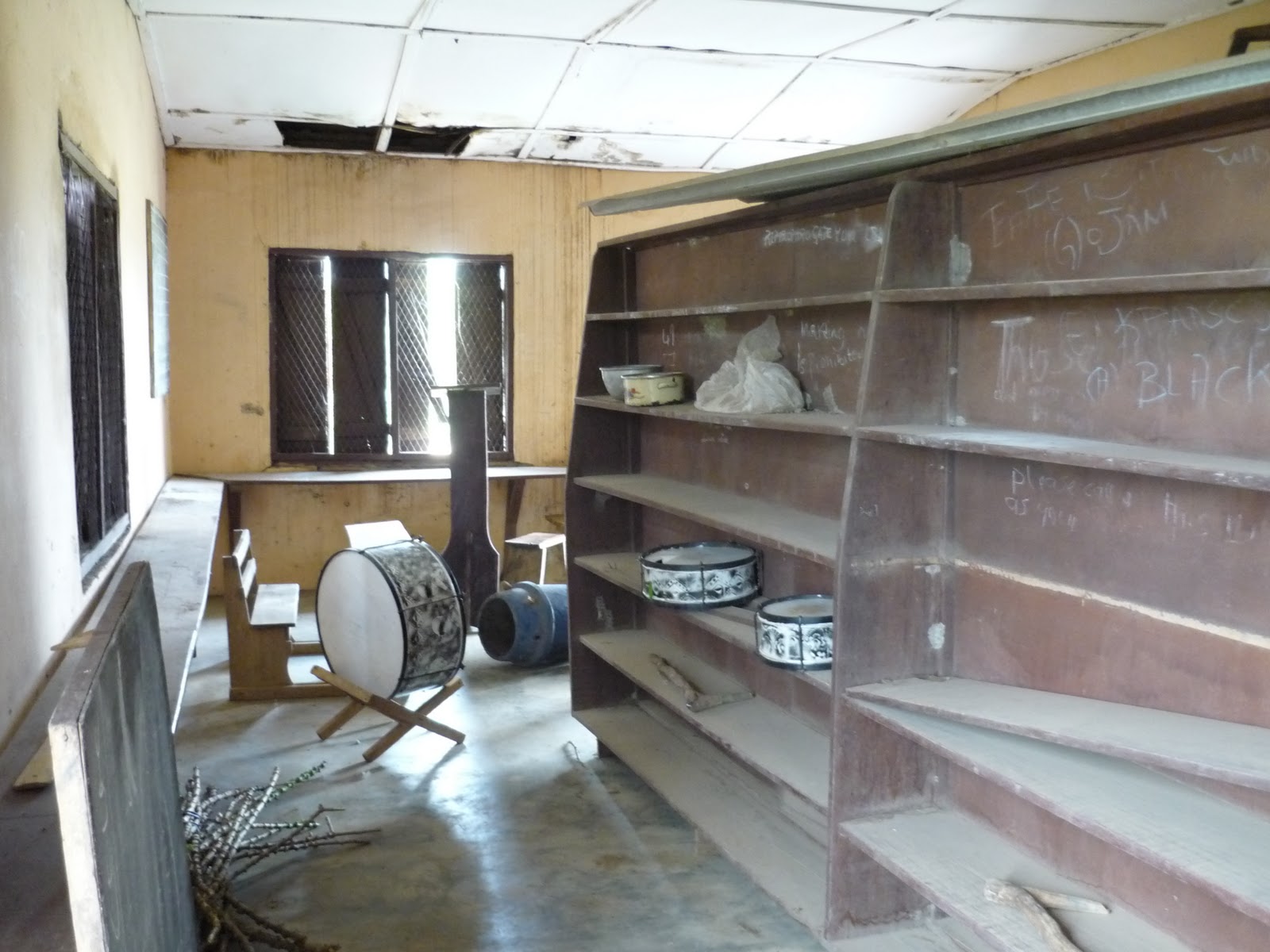
This project I am starting will put books in an already-established library space within one of the schools in Damanko.  The room is in this junior high school at the end of the building.  With the money that is donated, I and interested community members will refurbished the unused, slightly deteriorated library room—replace the window shutters for security, build furniture such as extra shelves and chairs, and paint the room to make it a productive and inspiring learning space. The bulk of the money, however, will go to buying books at a heavily discounted rate from the Ghana Book Trust in Accra and transporting them back to Damanko. The school community will provide all the labor, the management, and not to mention the actual building.  Or, instead, we will receive the bulk of the books from state-side book drives assisted by the African Library Project.  I'm waiting to see which one (or bits of both) will work out.

The library room has been acting as a store room for several years, so refurbishment is definitely needed, and, really looked forward to.


We hope to put about 300-500 books in the library.  My plan is to have half of those books be everything from Dr Seuss to Harry Potter; in other words, easy children's books to young adult/teen books. The other half will be interesting encyclopedic textbooks that are very topical and contain extra information about core subjects which currently have a dearth of resources—basic science, geography, geology, natural science, world cultures, and technology.

This small library will also allow the headmaster of the junior high school and I to start and maintain a Reading Club. Many students come into the the first year of junior high school with barely a first grade reading level. Teachers are forced to waste time starting at the ABCs. Having this library resource will give the teachers more teaching materials and will also encourage the students to improve their reading. It is hard to convince students to read and to read well when there is nothing entertaining to read and this skill becomes a utilitarian skill only.

Students like my friend Precious love to read but have nothing to read. Precious is a very bright student with big plans for her future. She is one of the few students who is a very accomplished reader, but her thirst for entertaining and enlightening things to read goes mostly unquenched. She has been working her way through my small personal Peace Corps stash of books. Right now she is tackling all seven of the Chronicles of Narnia books.


Other students like my friend Sudi, a teenager in junior high school, have great potential, but his reading suffers because of inconsistant teaching and no materials to encourage him or help him improve his reading.

Ebenezer is also in junior high and loves stories. He loves to perform and tell stories, and a lot of stories come from other storytellers. He reads moderately well, and tells me he would love more books so he can study them and tell more stories.

There are around 3,000 school children in Damanko, so 250-300 books may seem small and inadequate to you, but the community needs only a small repository that they can manage. And 250 books is more books than any of these students have seen cumulatively in their lives.

Please help these students discover the world in books! The link below will take you to a secure Peace Corps website where you can make your donations. Thank you in advance!

Friday, August 5, 2011

HIV, gender, and football....and betrayal

Where do I even begin?  What an eventful two weeks.  In fact, there was more “event” and, well, drama than I care for.  It’s funny how there’s months of nothing then all of a sudden BAM! The shit just hits the fan. 
Kwesi and I (well, especially Kwesi) had been looking forward to putting on these football tournaments for weeks.  We gathered soccer teams from smaller villages all around to host a tournament and give education about HIV and gender equality.  Peace Corps staff is busy with training a new group of volunteers and because training was to go an extra two weeks this year they decided to inject a bit of field training into the trainees’ schedules.  They asked us to plan PEPFAR (HIV/AIDS) events for a set of dates and they would send us trainees as minions to help with the projects.  The timing worked out so well that Peace Corps asked us to do two tournaments in two weeks, which we were able to do.  It was very exciting.  We were planning a big event and I was going to be able to be involved in the training aspect of Peace Corps.  I was looking forward to it.  Until our little hiccup.  Our grant was approved and I collected the money and brought it back to my house.  Kwesi and I spent a couple of days buying things mostly for the first tournament—balls, sodas, teaching materials, etc—until that Sunday when I opened my wooden chest in my house and found 500 cedis (400 something dollars) missing.  In the middle of planning for the arrival of 7 new people, the educational planning, and getting all the tournament ducks in a row, I now had to deal with this huge violated feeling.  Someone I trusted had come in and taken the money.  That was the only explanation.  An entire bundle of 5 cedis was missing. 

After a few days it became obvious who the culprit was.  A boy I had trusted and worked with closely for over a year, a boy who through a track record of good behavior had earned my trust enough to be left in my house alone for a few minutes, a boy I had invested many hours into trying to show him he had a future bigger than the village by showing and teaching him things he wouldn't get in the village.  Apparently all that meant nothing.  These are not decisions I make lightly, but nevertheless, it came back to bite me in the ass.  I made the mistake of thinking he was more mature than he actually was.  He began spending the money so it was easy, by then, to involve the chief and Joseph, when confronted, confessed to the act.  The things he bought were able to be returned and we recovered about two-thirds of the money and were able to avoid canceling the second tournament.  The feeling of violation and betrayal is quite overwhelming.  

Once we were able to set—mentally—this event aside, the tournaments went on without a hitch.  I am not really sure how impactful we were with the education, but I know everyone had a good time.  Each tournament was to span 3 days.  The first day was devoted to focused education for the players.  We had 8 teams of 11 twenty-something young men all in a room together.  Since there is a lot of HIV education here and a relatively low prevalence rate (for Africa) it’s common practice to inject other topics into PEPFAR events.  Since I had this specific demographic here, I decided to let them discuss gender topics relevant to their lives—roles, relationships, and sex.  I hope it was as illuminating for them as it was for me. 

It has been obvious to me for a while that I am witnessing a country in transition.  When many go outside the Western world, they are confronted and frustrated by a people rooted in traditions and old, oppressive ideas, especially with respect to gender.  Ghana is right in the middle of that old and new tug-of-war, and the catalyst, very vocally stated, is education.  When one attends school and finishes they enter into this elite rank of Educated which immediately marks you as having certain beliefs and certain behaviors.  To be uneducated means you have no idea how to operate in a modern Ghana.  Educated Ghanaian men have certain beliefs regarding the rigidity of men and women’s roles and expectations in life.  They want to fit in with the modern world.  The “uneducated” ones as you can imagine are less enlightened.  Yet they will still follow their educated brethren up to a point.

After talking about the expectations of men and women in this culture, we read some statements to act as a catalyst for discussion—whether they agreed or disagreed with them.  The one that was most interesting was whether it was easier to be a man than a woman.  One group said that their lives are so different there’s no comparison.  Life is difficult for everyone.  For others it was a little difficult to draw an honest answer.  Most of them see that Ghana is changing; it’s impressing them with the awareness that they are at the forefront of that change and to do that role justice that’s hard.  And that if they choose to keep the same roles they have always kept—men the breadwinners, women the house—then they need to do those jobs with the utmost integrity and respect, and allow people the choice to live outside those roles.

But you can only keep their attentions so long when there’s football to be had.  Everyone played well and magnanimously, except for one team whom I nearly disqualified for threatening the referees.  I had left 99% of the football up to Kwesi to completely organize and run, so I only looked on with a perplexed look when he started officiating one of the matches.  If I had known sooner why he was doing that, I would have disqualified the team, but instead, I laid the smackdown on them before their second match (shaking and squeaking with anger) and they shaped up.

The second tournament went a lot smoother than the first one, yet the first one seemed to have more glory.  The championship game was a real nail-biter too.  Several of the matches (including the final match) went into penalty kicks which really turns into utter chaos.  Even though Kwesi was almost entirely responsible for organizing the football matches, it was incredibly satisfying to see so many turn out for something you had a hand in.  That and the vanity in me is just happy to know I’m capable of organizing such a massive event.  The trainees I had really stepped up too.  During the games we did some impromptu, small group education using pictures about proper sanitation and malaria.  They really jumped in there and were a big help.  I was really impressed with their lack of timidity.  Maybe that’s because some of them are just crazy.