The last couple of weeks have been pretty fruitful. About a week after I got back to Damanko after returning from America, we had a community meeting about the direction of the library project. I told the various teachers, headmasters, and PTA people about the library program we had an option of participating in. Everyone was very excited about the prospect of getting some help furnishing the library. I told them the biggest obstacle was getting the books from Accra to Damanko. They took that problem and immediately went to work figuring out how to solve it. Somehow, they got all the tribal leaders in the town to pledge some money for the transport. If they can actually collect the money for it, it will be an amazing step of good faith by a community in a country that expects the white world to provide all the funds for everything. I am very proud of them. I don't want to say more about the library project at the moment in case I might jinx it. I'll save it for when it actually happens.
I also started a Girls' Club to talk about issues teeage girls face around here. Teenage pregnancy is one of the biggest problems in many communities in this country, so here is my small little stab at it. The purpose of the club is to be a kind of youth group to talk about those life-things that seem quite abstract here since nobody really talks about them. Subjects like: goal planning, decision making, self-esteem, relationships, boys, sex, being assertive, gender roles and equality issues, how to spot inequality and fight it, etc. The hardest part I've found already is how to talk to them about these issues so they understand what I'm saying. I'm so used to talking to educated people who are familiar with these issues, how do I approach these complex and complicated issues so that young girls with a basic but usable grasp of English can understand me? I have so much knowledge to give them, how do I keep it from going over their heads?
So anyway, that's a short update about the most important things I'm doing currently. One of these days I'll a detailed write up of them.
Friday, November 25, 2011

Thursday, September 22, 2011
Introducing the Damanko School Library Project
One of the biggest obstacles to a well-rounded education in Africa is the lack of access to books. Any kind of books—books full of facts about interesting subjects or just books that are enjoyable to read. Students in school learn to read, but learning anything well takes practice, but there are no books to help them improve their reading. Aside from some well-used minimal textbooks, they have nothing to show them the magic of books and world remains a little bit smaller. Their reading levels remain sub-par and moving through school remains difficult.
 This project I am starting will put books in an already-established library space within one of the schools in Damanko. The room is in this junior high school at the end of the building. With the money that is donated, I and interested community members will refurbished the unused, slightly deteriorated library room—replace the window shutters for security, build furniture such as extra shelves and chairs, and paint the room to make it a productive and inspiring learning space. The bulk of the money, however, will go to buying books at a heavily discounted rate from the Ghana Book Trust in Accra and transporting them back to Damanko. The school community will provide all the labor, the management, and not to mention the actual building. Or, instead, we will receive the bulk of the books from state-side book drives assisted by the African Library Project. I'm waiting to see which one (or bits of both) will work out.
The library room has been acting as a store room for several years, so refurbishment is definitely needed, and, really looked forward to.


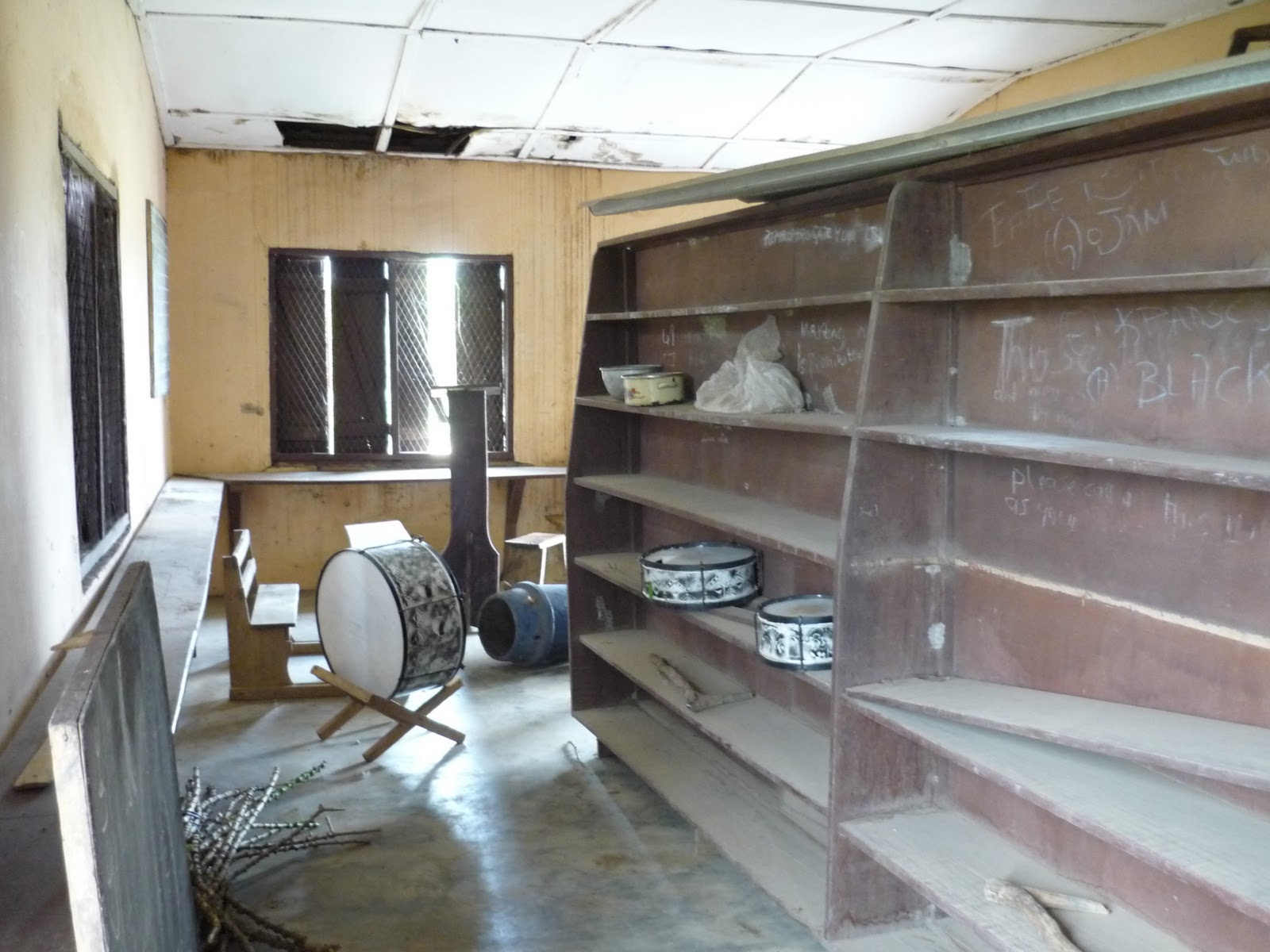
We hope to put about 300-500 books in the library. My plan is to have half of those books be everything from Dr Seuss to Harry Potter; in other words, easy children's books to young adult/teen books. The other half will be interesting encyclopedic textbooks that are very topical and contain extra information about core subjects which currently have a dearth of resources—basic science, geography, geology, natural science, world cultures, and technology.
This small library will also allow the headmaster of the junior high school and I to start and maintain a Reading Club. Many students come into the the first year of junior high school with barely a first grade reading level. Teachers are forced to waste time starting at the ABCs. Having this library resource will give the teachers more teaching materials and will also encourage the students to improve their reading. It is hard to convince students to read and to read well when there is nothing entertaining to read and this skill becomes a utilitarian skill only.

Students like my friend Precious love to read but have nothing to read. Precious is a very bright student with big plans for her future. She is one of the few students who is a very accomplished reader, but her thirst for entertaining and enlightening things to read goes mostly unquenched. She has been working her way through my small personal Peace Corps stash of books. Right now she is tackling all seven of the Chronicles of Narnia books.
Other students like my friend Sudi, a teenager in junior high school, have great potential, but his reading suffers because of inconsistant teaching and no materials to encourage him or help him improve his reading.
Ebenezer is also in junior high and loves stories. He loves to perform and tell stories, and a lot of stories come from other storytellers. He reads moderately well, and tells me he would love more books so he can study them and tell more stories.
There are around 3,000 school children in Damanko, so 250-300 books may seem small and inadequate to you, but the community needs only a small repository that they can manage. And 250 books is more books than any of these students have seen cumulatively in their lives.
Please help these students discover the world in books! The link below will take you to a secure Peace Corps website where you can make your donations. Thank you in advance!
Friday, August 5, 2011
HIV, gender, and football....and betrayal
Where do I even begin? What an eventful two weeks. In fact, there was more “event” and, well, drama than I care for. It’s funny how there’s months of nothing then all of a sudden BAM! The shit just hits the fan.
Kwesi and I (well, especially Kwesi) had been looking forward to putting on these football tournaments for weeks. We gathered soccer teams from smaller villages all around to host a tournament and give education about HIV and gender equality. Peace Corps staff is busy with training a new group of volunteers and because training was to go an extra two weeks this year they decided to inject a bit of field training into the trainees’ schedules. They asked us to plan PEPFAR (HIV/AIDS) events for a set of dates and they would send us trainees as minions to help with the projects. The timing worked out so well that Peace Corps asked us to do two tournaments in two weeks, which we were able to do. It was very exciting. We were planning a big event and I was going to be able to be involved in the training aspect of Peace Corps. I was looking forward to it. Until our little hiccup. Our grant was approved and I collected the money and brought it back to my house. Kwesi and I spent a couple of days buying things mostly for the first tournament—balls, sodas, teaching materials, etc—until that Sunday when I opened my wooden chest in my house and found 500 cedis (400 something dollars) missing. In the middle of planning for the arrival of 7 new people, the educational planning, and getting all the tournament ducks in a row, I now had to deal with this huge violated feeling. Someone I trusted had come in and taken the money. That was the only explanation. An entire bundle of 5 cedis was missing.
After a few days it became obvious who the culprit was. A boy I had trusted and worked with closely for over a year, a boy who through a track record of good behavior had earned my trust enough to be left in my house alone for a few minutes, a boy I had invested many hours into trying to show him he had a future bigger than the village by showing and teaching him things he wouldn't get in the village. Apparently all that meant nothing. These are not decisions I make lightly, but nevertheless, it came back to bite me in the ass. I made the mistake of thinking he was more mature than he actually was. He began spending the money so it was easy, by then, to involve the chief and Joseph, when confronted, confessed to the act. The things he bought were able to be returned and we recovered about two-thirds of the money and were able to avoid canceling the second tournament. The feeling of violation and betrayal is quite overwhelming.
Once we were able to set—mentally—this event aside, the tournaments went on without a hitch. I am not really sure how impactful we were with the education, but I know everyone had a good time. Each tournament was to span 3 days. The first day was devoted to focused education for the players. We had 8 teams of 11 twenty-something young men all in a room together. Since there is a lot of HIV education here and a relatively low prevalence rate (for Africa) it’s common practice to inject other topics into PEPFAR events. Since I had this specific demographic here, I decided to let them discuss gender topics relevant to their lives—roles, relationships, and sex. I hope it was as illuminating for them as it was for me.
It has been obvious to me for a while that I am witnessing a country in transition. When many go outside the Western world, they are confronted and frustrated by a people rooted in traditions and old, oppressive ideas, especially with respect to gender. Ghana is right in the middle of that old and new tug-of-war, and the catalyst, very vocally stated, is education. When one attends school and finishes they enter into this elite rank of Educated which immediately marks you as having certain beliefs and certain behaviors. To be uneducated means you have no idea how to operate in a modern Ghana. Educated Ghanaian men have certain beliefs regarding the rigidity of men and women’s roles and expectations in life. They want to fit in with the modern world. The “uneducated” ones as you can imagine are less enlightened. Yet they will still follow their educated brethren up to a point.
After talking about the expectations of men and women in this culture, we read some statements to act as a catalyst for discussion—whether they agreed or disagreed with them. The one that was most interesting was whether it was easier to be a man than a woman. One group said that their lives are so different there’s no comparison. Life is difficult for everyone. For others it was a little difficult to draw an honest answer. Most of them see that Ghana is changing; it’s impressing them with the awareness that they are at the forefront of that change and to do that role justice that’s hard. And that if they choose to keep the same roles they have always kept—men the breadwinners, women the house—then they need to do those jobs with the utmost integrity and respect, and allow people the choice to live outside those roles.
But you can only keep their attentions so long when there’s football to be had. Everyone played well and magnanimously, except for one team whom I nearly disqualified for threatening the referees. I had left 99% of the football up to Kwesi to completely organize and run, so I only looked on with a perplexed look when he started officiating one of the matches. If I had known sooner why he was doing that, I would have disqualified the team, but instead, I laid the smackdown on them before their second match (shaking and squeaking with anger) and they shaped up.
The second tournament went a lot smoother than the first one, yet the first one seemed to have more glory. The championship game was a real nail-biter too. Several of the matches (including the final match) went into penalty kicks which really turns into utter chaos. Even though Kwesi was almost entirely responsible for organizing the football matches, it was incredibly satisfying to see so many turn out for something you had a hand in. That and the vanity in me is just happy to know I’m capable of organizing such a massive event. The trainees I had really stepped up too. During the games we did some impromptu, small group education using pictures about proper sanitation and malaria. They really jumped in there and were a big help. I was really impressed with their lack of timidity. Maybe that’s because some of them are just crazy.
Saturday, July 16, 2011
In a funk
I’ve been in a bit of a funk lately. Maybe it’s the I’ve-been-here-a-year-already blues, but this “funk” has been pretty hard to shake. I’ve been A LOT more easily irritated. Things that I used to be able to roll off my shoulder, now, after a year of build up, make me have a minor stroke. Things that were soothing balms before are now losing their effectiveness. I’ve been keeping to the house a lot more lately. It’s just a lot easier on my nerves. Just aimlessly walking the paths of the village doesn’t hold the same appeal it once did. Walking to the river isn’t as interesting. I’m just tired of people yelling at me every time I go out. I don’t understand how people can’t see that after a year of being hollered at, and by the same (in my opinion) disrespectful word, it really gets old. People speaking in a language they know I don’t understand, just so they can laugh at my incomprehension gets old too. The sense of newness and adventure that just being in and wandering around the village just doesn’t outweigh the irritations anymore. I really only want to go out if I have some work to do, and even that feels like it occurs less than it should. These irritations are only the symptoms of a greater disease—the one of self-frustration. It’s been a year now, and when I think about where I thought I was going to be at this point in my service, and where I actually am, the funk follows. Graduate school really honed my brain muscle and it was at the peak of its best intellectual shape when I stepped off the plane in Accra. I could see a clear path of goals, because the path I was embarking on followed quite closely to the intense previous two years. I had dreams about accomplishing certain things that I knew were a bit of a pipe dream, but there were also things that I didn’t think, given the previous two years, I would fail at. Language for instance. I joined Peace Corps to learn another language. Even at the beginning of training I was determined not be one of those volunteers that didn’t learn the local language. But, a year in, I’ve given up any hope of even moderate fluency. As much as I want I just can’t seem to learn it beyond the simplest conversations. A year in, much of it still sounds like gibberish, I can’t even get the gist of a conversation by two competent speakers. People can totally talk about me without me knowing it. I even got a language tutor, and Gideon is great, but it doesn’t seem to be helping beyond the most miniscule of improvements.
I felt at the beginning of this, I had an advantage being shoved into a great practical professional opportunity in prime intellectually academic shape. This was my chance to avoid the career crisis trap that most anthropologists and academics face when they decide their degrees were useless. I was determined not to get to that place, and what better way to do that than to do exactly what anthropologists have always done? It was my chance to do what my professional forefathers had done, what my own “colleagues” were currently doing. I was going to develop professionally, do cultural research, find a subject, do all the methods, find something publishable, get some qualitative experience under my belt, so I could walk into a future interview and say, “Yeah, I’ve done that, and this is how it worked.” I don’t even have a reason why this hasn’t happened. No reason at all.
Some frustrations are more immediate. I’ve had a dozen ideas in the last year, that for one reason or another, just haven’t gotten to the Execute stage. Many of these are probably due to my lack of problem solving abilities. Motivation has been an issue as well—for me and for others.
I’ve been here a year and what do I have to show for it really? A few projects have been successful, but I can only ride those so long. I have a few good acquaintances, but not enough. I can’t speak the language, no great epiphanies, and haven’t contributed to Peace Corps in any great valuable way. I have half a dozen things I’ve wanted to start, but can’t seem to start them, and just seem to be doing too much “hanging out” and wasting time, a fat lot of waiting really.
There are some good things on the horizon, but I feel a bit lost. I guess, even after a year, I haven’t found my niche in this job. I was certain graduate school was going my allow me to hit the ground running, but it hasn’t turned out that way. I am supposed to be doing health work in Damanko, but I’ve always thought that job description in Peace Corps was a bunch of rot. I’m a community development worker—if the community needs health work, then I’ll do that, but they need other things. In fact, I’ve found that Damanko doesn’t really need my “health work.” All the technical training I had, the knowledge Peace Corps gave to me based on Ghana’s health goals and national projects, I’ve found is really not needed. All that knowledge is here. The people know it, the proper social workers know it, the apparatus is in place for appropriate interventions if only they’d follow through. None of my ideas are new, they know it all. Motivating them to do it is the key, and that’s honestly something I can’t do. They know malaria comes from mosquitoes, HIV from unprotected sex, shitting in the bush spreads disease, etc. It’s the behavior change that needs to happen. They know they need to sleep under nets, wear condoms, and build a latrine to shit in, but they don’t for various reasons, but one of those reasons is not ignorance. Peace Corps is all about creating behavior change, but through education. How are you supposed to create behavior change using education when they know these things already?
So I’ve decided to change tracks—focus on gender and environment issues (though not necessarily together but not opposed to it either). The conversations that aren’t being had here are about the environment—depletion of forests for firewood, over hunting and over fishing, degradation of farm land, etc. Problem is, since Peace Corps’ cross-sector training is scarce, I don’t have the training to handle these problems, but maybe I can at least get them started.
Tuesday, June 21, 2011
Actively molding young minds: Inspiring world change through Camp GGLOW
Last week, we Nkwanta Peace Corps volunteers participated in one of the most rewarding events of Peace Corps—Camp GGLOW. Each of us chose five junior high school students from our villages and met in Nkwanta for a 4-day workshop/camp event. It was an incredible week.
For most kids in this area, finishing school is a doable, if difficult task. For some it is nearly impossible, and for most it’s incredibly more difficult than it should be. Education is not free. The Ghana Education Service may say it is, but fees trip up families at every turn. There are uniform fees, test fees, extra class fees, supply fees, even end-of-term exam fees. Many attitudes toward education are reminiscent of America fifty years ago—children’s labor is needed for the farm; there are no opportunities so education is irrelevant; or just basic devaluing of education. Yet the biggest obstacle remains to be the money. Even if they can afford the fees, it is a struggle from term to term, and sacrifices are made by everyone as financial support may not come only from the parents. Money concerns keep the parents from enrolling their children, but the students’ attitude obstacles are many more, especially when they hit the junior high age. Many don’t see school as beneficial to them or just want to spend their time helping their households generate income. Or they just plain aren’t responsible kids and neglect their school work. Many don’t make goals for their lives, or at least have no idea how to achieve them. Girls are coerced into sex too early and get pregnant—all too often by their own teachers. Girls’ education is passed over in favor of their brothers’ education because they can only afford to send one. The pitfalls are many, but so are the inspirations. Camp GGLOW is an opportunity to take 5 serious and high-performing students and show them that succeeding is possible and to not give up. I don’t know whether the five students I took were at risk for not moving on to senior high school, but I hope now they realize that any of the sacrifices they make will be worth it. I also found 5 new friends.
I thought it would be best if I had the teachers choose which students they thought deserved to go to such an extracurricular event. In many cases they chose high performing students who were already in leadership positions chosen by their fellow students. I told the two bigger junior high schools to recommend a boy and a girl and I told the smaller one to choose one girl.
Mark is one of those tall giants who doesn’t live up to his size. He is a reserved and quiet boy of about 16 and unfailingly polite. He doesn’t offer long explanations easily when directly asked, but participates well in class discussions. His family lives in Pibilla, a super tiny village about 7 miles from Damanko. There is a primary school there, but if kids want to continue with school, they must traverse those seven miles by foot or by bike to school everyday. Mark is lucky that he is able to stay with his brother in Damanko for many of the school days.
Enam is the daughter of the head nurse in Damanko. In fact, she says that she wants to become a nurse when she is finished with school—a popular profession with many kids. She enjoys sports too. She is on her school’s girls’ football team, and while at camp, took any opportunity to play volleyball or frisbee or even Capture the Flag.
Ama is still a bit of a mystery. She is very quiet and tends to blend into a crowd very well—so well that I had to search many faces closely before I could find her. She is a very serious student; her teachers tell me she never misses school, a quite rare ability.
Ebenezer is my performer of the group. He is a powerfully-built kid with broad shoulders, a short stature, a sharp mind and affable personality with a knack for telling stories. His lack of shyness makes him a defacto leader of any group, something he handles easily.
Rafia was my pleasant surprise. My only student from the English-Arabic Muslim school, she was my dark horse. When I first met her, I could barely hear her speak and she seemed bewildered easily. Over the weeks before camp she visited me often, but still did not speak much or loudly. Often in school, unless the girl is exceptionally bold, we have to encourage them specifically to speak, because the boys like to take over and the girls tend to let them. I watched Rafia a lot, trying to find what piqued her interest. She was very attentive during all our sessions, but seemed on the edge of her seat during the ICT lessons and during PCV Raj’s impromptu one during free time, she was there in small group surrounding his screen. She even knew many of the answers to the ICT questions, though I’m sure she had never handled a computer until camp. Rafia’s got a voice too. During Thursday night’s talent show where we let the kids showcase whatever they could do, Rafia got up and sang a song in Arabic all on her own. She did it again the next night when we did cultural dancing. She sings very very well. At camp I saw a whole new side, and she blew my mind more than a little when she announced she dreamt of becoming a pilot. I think I found my girl.
The camp is a weird mix between a semi-professional workshop and American campy-ness. We tried to keep it from being too much like a workshop by inserting activities like tie-dying t-shirts and playing Capture the Flag. We had sessions about “Life Skills” which is a major point of emphasis for Peace Corps—teaching kids how to make good decisions and stay out of trouble and to keep their eyes on their goals. We brought in a lot of professional people to talk about a variety of subjects—gender equality, health, HIV/AIDS, wildlife conservation, etc—not only to expose them to issues not talked about in school, but also to show them the variety of professions people have even in their own backyards.
We held the camp in the “medical village” which is basically a campus for the hospital in Nkwanta. It has a large space, a conference room, some dorm space for the kids to sleep in, and bungalows for us. Dr Tony, the director of the hospital, led a session on HIV/AIDS. HIV is surprisingly not a big issue in Ghana, with a prevalence rate of only 2%, and most kids get plenty of HIV education in school. Because we were able to supply computers and a projector for this event, plus a highly educated doctor, Dr Tony was able to show them clinical pictures of many of the opportunistic infections that affect AIDS patients which the kids have never seen before.
Selorm came from one of the NGOs in town to talk about gender equality, something the kids intuitively understand, but rarely see. Fuseini from nearby Kyabobo National Park was invited to talk about his work and the kids’ reaction was very interesting. The idea of conservation and protected animal species flies a good six feet over their heads. Cultural mentality is that animals are here for us to use or eat, because surely they would do the same to us, and setting up a system that protects the natural processes and lifestyles of animals seems odd and useless. All week they had been absorbing really well all of the things we were giving them, but this concept eluded them.
The highlight of our guest speakers was Grace, one of our Ghanaian Peace Corps staff. She may be responsible for only the training of new PCVs, but her passion is really working with youth, especially young girls. She has one of those truly rags-to-riches stories that makes everyone sit up and take notice. She runs all of the training for Peace Corps Ghana, has a master’s degree, and is highly respected by everyone, but like some of the students, she came from a rural village, was told not to go to school because educating girls was a waste of time and money, and struggled to make ends meet the whole time.
We had a theme for our camp—Leadership Around the World. As Peace Corps volunteers we know that one of the best things we can do in these communities is just to show the world outside of their villages, outside of Ghana, so that’s what we tried to do. We showed Planet Earth during lunch breaks, did small presentations on countries or regions of the world. We had a globe and a world map and hammered some geography into them because maps are something they rarely see and most cannot do more than point out Ghana on the map. We made sure they knew the continents and even went as far as naming the planets.
The evenings were the most entertaining. The first night, since we had the benefit of our computers, a projector, and the vast PCV digital library (that is spread among everyone’s hard-drives) we showed a couple animated movies. The first night was Megamind, the second, How to Train Your Dragon. Both went over really well because they’re full of action and funny mannerisms. Ghana has its own movie industry and a lot of influx from Nigeria, but they rarely, if ever, see American animated films. On Thursday, we had a talent show which most kids used as a platform for singing or dancing or telling stories. Little Bernard shocked everyone with his animal noises, and another boy with his break-dancing.
It seemed like the event was a success; everyone bonded well, was active, and seemed to have a good time. I sincerely hope, though, that at least a couple of my kids feel better and more hopeful about their future, because really, they have their whole lives ahead of them and they can become and do anything. I hope to use these five kids and Camp GGLOW as a spring board for some other things. I’m sure they’ll want to start an ICT club, knowing now that I have a computer. I want to try and start a girls’ club with Ama, Rafia, and Enam and ask them to invite the friends they know are having trouble, so we can use the Camp GGLOW tools to help them. It’s all about paying it forward.
For most kids in this area, finishing school is a doable, if difficult task. For some it is nearly impossible, and for most it’s incredibly more difficult than it should be. Education is not free. The Ghana Education Service may say it is, but fees trip up families at every turn. There are uniform fees, test fees, extra class fees, supply fees, even end-of-term exam fees. Many attitudes toward education are reminiscent of America fifty years ago—children’s labor is needed for the farm; there are no opportunities so education is irrelevant; or just basic devaluing of education. Yet the biggest obstacle remains to be the money. Even if they can afford the fees, it is a struggle from term to term, and sacrifices are made by everyone as financial support may not come only from the parents. Money concerns keep the parents from enrolling their children, but the students’ attitude obstacles are many more, especially when they hit the junior high age. Many don’t see school as beneficial to them or just want to spend their time helping their households generate income. Or they just plain aren’t responsible kids and neglect their school work. Many don’t make goals for their lives, or at least have no idea how to achieve them. Girls are coerced into sex too early and get pregnant—all too often by their own teachers. Girls’ education is passed over in favor of their brothers’ education because they can only afford to send one. The pitfalls are many, but so are the inspirations. Camp GGLOW is an opportunity to take 5 serious and high-performing students and show them that succeeding is possible and to not give up. I don’t know whether the five students I took were at risk for not moving on to senior high school, but I hope now they realize that any of the sacrifices they make will be worth it. I also found 5 new friends.
I thought it would be best if I had the teachers choose which students they thought deserved to go to such an extracurricular event. In many cases they chose high performing students who were already in leadership positions chosen by their fellow students. I told the two bigger junior high schools to recommend a boy and a girl and I told the smaller one to choose one girl.
Mark is one of those tall giants who doesn’t live up to his size. He is a reserved and quiet boy of about 16 and unfailingly polite. He doesn’t offer long explanations easily when directly asked, but participates well in class discussions. His family lives in Pibilla, a super tiny village about 7 miles from Damanko. There is a primary school there, but if kids want to continue with school, they must traverse those seven miles by foot or by bike to school everyday. Mark is lucky that he is able to stay with his brother in Damanko for many of the school days.
Enam is the daughter of the head nurse in Damanko. In fact, she says that she wants to become a nurse when she is finished with school—a popular profession with many kids. She enjoys sports too. She is on her school’s girls’ football team, and while at camp, took any opportunity to play volleyball or frisbee or even Capture the Flag.
Ama is still a bit of a mystery. She is very quiet and tends to blend into a crowd very well—so well that I had to search many faces closely before I could find her. She is a very serious student; her teachers tell me she never misses school, a quite rare ability.
Ebenezer is my performer of the group. He is a powerfully-built kid with broad shoulders, a short stature, a sharp mind and affable personality with a knack for telling stories. His lack of shyness makes him a defacto leader of any group, something he handles easily.
Rafia was my pleasant surprise. My only student from the English-Arabic Muslim school, she was my dark horse. When I first met her, I could barely hear her speak and she seemed bewildered easily. Over the weeks before camp she visited me often, but still did not speak much or loudly. Often in school, unless the girl is exceptionally bold, we have to encourage them specifically to speak, because the boys like to take over and the girls tend to let them. I watched Rafia a lot, trying to find what piqued her interest. She was very attentive during all our sessions, but seemed on the edge of her seat during the ICT lessons and during PCV Raj’s impromptu one during free time, she was there in small group surrounding his screen. She even knew many of the answers to the ICT questions, though I’m sure she had never handled a computer until camp. Rafia’s got a voice too. During Thursday night’s talent show where we let the kids showcase whatever they could do, Rafia got up and sang a song in Arabic all on her own. She did it again the next night when we did cultural dancing. She sings very very well. At camp I saw a whole new side, and she blew my mind more than a little when she announced she dreamt of becoming a pilot. I think I found my girl.
The camp is a weird mix between a semi-professional workshop and American campy-ness. We tried to keep it from being too much like a workshop by inserting activities like tie-dying t-shirts and playing Capture the Flag. We had sessions about “Life Skills” which is a major point of emphasis for Peace Corps—teaching kids how to make good decisions and stay out of trouble and to keep their eyes on their goals. We brought in a lot of professional people to talk about a variety of subjects—gender equality, health, HIV/AIDS, wildlife conservation, etc—not only to expose them to issues not talked about in school, but also to show them the variety of professions people have even in their own backyards.
We held the camp in the “medical village” which is basically a campus for the hospital in Nkwanta. It has a large space, a conference room, some dorm space for the kids to sleep in, and bungalows for us. Dr Tony, the director of the hospital, led a session on HIV/AIDS. HIV is surprisingly not a big issue in Ghana, with a prevalence rate of only 2%, and most kids get plenty of HIV education in school. Because we were able to supply computers and a projector for this event, plus a highly educated doctor, Dr Tony was able to show them clinical pictures of many of the opportunistic infections that affect AIDS patients which the kids have never seen before.
Selorm came from one of the NGOs in town to talk about gender equality, something the kids intuitively understand, but rarely see. Fuseini from nearby Kyabobo National Park was invited to talk about his work and the kids’ reaction was very interesting. The idea of conservation and protected animal species flies a good six feet over their heads. Cultural mentality is that animals are here for us to use or eat, because surely they would do the same to us, and setting up a system that protects the natural processes and lifestyles of animals seems odd and useless. All week they had been absorbing really well all of the things we were giving them, but this concept eluded them.
The highlight of our guest speakers was Grace, one of our Ghanaian Peace Corps staff. She may be responsible for only the training of new PCVs, but her passion is really working with youth, especially young girls. She has one of those truly rags-to-riches stories that makes everyone sit up and take notice. She runs all of the training for Peace Corps Ghana, has a master’s degree, and is highly respected by everyone, but like some of the students, she came from a rural village, was told not to go to school because educating girls was a waste of time and money, and struggled to make ends meet the whole time.
We had a theme for our camp—Leadership Around the World. As Peace Corps volunteers we know that one of the best things we can do in these communities is just to show the world outside of their villages, outside of Ghana, so that’s what we tried to do. We showed Planet Earth during lunch breaks, did small presentations on countries or regions of the world. We had a globe and a world map and hammered some geography into them because maps are something they rarely see and most cannot do more than point out Ghana on the map. We made sure they knew the continents and even went as far as naming the planets.
The evenings were the most entertaining. The first night, since we had the benefit of our computers, a projector, and the vast PCV digital library (that is spread among everyone’s hard-drives) we showed a couple animated movies. The first night was Megamind, the second, How to Train Your Dragon. Both went over really well because they’re full of action and funny mannerisms. Ghana has its own movie industry and a lot of influx from Nigeria, but they rarely, if ever, see American animated films. On Thursday, we had a talent show which most kids used as a platform for singing or dancing or telling stories. Little Bernard shocked everyone with his animal noises, and another boy with his break-dancing.
It seemed like the event was a success; everyone bonded well, was active, and seemed to have a good time. I sincerely hope, though, that at least a couple of my kids feel better and more hopeful about their future, because really, they have their whole lives ahead of them and they can become and do anything. I hope to use these five kids and Camp GGLOW as a spring board for some other things. I’m sure they’ll want to start an ICT club, knowing now that I have a computer. I want to try and start a girls’ club with Ama, Rafia, and Enam and ask them to invite the friends they know are having trouble, so we can use the Camp GGLOW tools to help them. It’s all about paying it forward.
Friday, May 27, 2011
Exciting work is coming!
Finally ideas are beginning to gain momentum. I came away from the All Volunteer Conference earlier this month with lots of ideas and now some of them are starting to happen. We’ve all but finished the latrine project—all that’s left is the final evaluation for the NGO. With the help of World Vision (and the District Assembly when they finally release the money), we helped 25 families in Damanko afford latrines for their households. Now they don’t have to go to the bush to take a dump. Now it’s time to move on to other things.
Camp GGLOW will be in a couple weeks, and I’m real excited for that. Some years ago some volunteers in some other country started a camp program for instilling leadership skills and inspiration in young girls (in our case young guys too). Now, many of them are held in Ghana, and those of us who are in the Nkwanta area are making our own. I could only take five junior high students, so I went to the two junior high schools in town and asked the teachers to choose a boy and a girl from each. I also asked the teachers from the smaller English-Arabic (Muslim) school to choose a girl for me. I am very happy with their choices and look forward to taking these kids to Nkwanta for a week. I expect it to be as crazy and silly fun as American camp is, which is something these kids will never have even heard of before. There should be 60 to 70 kids all held in the conference area of Nkwanta’s hospital and we’ll talk to them about life after school, finishing school, boy-girl stuff, health, decision-making, goal setting, etc. I can’t wait to see how they do.
One of the more popular events the previous volunteers in Damanko planned was a large soccer tournament which Kwesi is eager to replicate. Football is a big draw around here, so it offers a rich opportunity to educate people about any number of subjects. Since we have this lucrative pot of gold program called PEPFAR, it will be an HIV/AIDS Football Tournament. We invite football teams from the surrounding bush villages and provide focused education to the team players, and then to the crowd in between matches. We’ll even set up free testing at the clinic. The whole thing should last three days and be a whole lot of fun. The thing I’m excited about is that we were able to coincide this event with Peace Corps’ training program, so for this event, PC will send us several of the new volunteers who will be arriving in country in about a week. They won’t come to us until the end of July.
I’ve also organized ten or so kids to participate in a nationwide art contest focused on HIV/AIDS prevention messages. Plenty of kids like to draw, but don’t often get the chance, so now I’ve got several of them in my house the past few afternoons drawing all kinds of things.
Next week we’ll start my vegetable garden experiment. I bought seeds for carrots, green peppers, cabbage, cucumbers, and green beans in Tamale so we’ll see if they can grow here. If they do, it will be a great opportunity for some to farm some extra vegetables for the market. We’ll transform half of my “yard” into the garden and add tomato and basil plants. We’ll also start nursing moringa trees. Any seeds I don’t use, I’ll give to Joseph so he can start his own little garden too, and maybe it will help ease some of the income stress he feels.
Balls are rolling and it's exciting. Wish you all could see it!
Monday, May 9, 2011
Kristi's Ongoing Conversations with Herself (Again): Behind Western Eyes
“Women do all the work while men sit under the mango tree.”
I hate this statement. It took me a while to determine why exactly I felt so uncomfortable whenever I heard it. This is a well-worn idiom and opinion among volunteers, particularly female ones. I hear it, its variations, and references to it all the time. I thought just the fact that it was a broad, generalized, painting-all-with-the-same-brush kind of statement that bothered me, but it wasn’t. I kept looking for observational evidence to back up this statement in my own community, but I couldn’t—at least enough to participate in its repetition. I did see evidence to warrant this statement, but I also saw plenty of contradictions, and it’s the second bit that’s absent from this trope and the basis of my insecurity with it. So here is what I see:
If we do compare “women’s work” to “men’s work,” then the scale is definitely unbalanced. Women, as everywhere else in the world, have responsibility over the things that keep a household running—cooking, cleaning, childcare, keeping the house stocked, etc. Things we are all familiar with. Women also do many things to make their own money. They have small informal businesses (selling prepared food, pure water, products, etc); formal businesses (sewing, hairdressing, baking, store ownerships); they do trading in the market place on a very large scale, or, if they continue in school, nursing, teaching, and whatever else they dream. All this they do with childcare seamlessly woven into it. If women can do any of these things, she has considerable financial autonomy from the men in her life. They also have farms—groundnuts, okro, peppe, tomatoes, etc. Men have occupations, trades, or, if they farm, it’s often yams (as they take A LOT more physical labor) or rice. Men will sell these as cash crops, because it is his responsibility to provide hard cash for his family. Women’s money, if their husband is able to fill his role, retains her own, but if all is not peach-keen, it could very well fall to her to provide financially as well. But, just because women are responsible for all this work doesn’t mean she does it everyday or all the time or even alone. Households consist of many women and daughters to do the housework and childcare. Women may start and stop their businesses based on time, desire, or income. Households consist of many men who can bring an income or help on the farm. Depending on seasons, people may not go to farm everyday. Their schedules are incredibly flexible.
So because of all this flexible time, I see men sitting around playing games under a mango tree, yes, but is it always the same men? I don’t know. If a man doesn’t have any work (and if you don’t you could at least farm something—everyone does to supplement income) then you are considered lazy. Women I see doing the housework, yes, but I also see them napping on benches in the afternoon, sitting in a group yakking and cracking groundnuts, getting their hair braided (which can take two hours or more) at a hairdressing shop, laughing with sisters and girlfriends as they go to fetch water. I see men hauling water in barrels all day for selling, carpenters working, tailors sewing, men repairing motorcycles and cars, drivers ferrying passengers out of town. Everyone works hard and everyone sits around. I don’t know how equal it is unless I actually sit and count up the minutes.
My frustration with this statement comes because I feel like its speaker is dismissing the contradictions in any given place. Especially if they come from a Western background, this statement shows that they come from a place with very specific feminist sensibilities; in many cases with the expectation of finding “oppressed” women. They are framing their observations in a purely Western feminist context (with all its unique histories and indicators) which doesn’t belong here. I have been fortunate that during the development of my feminist theoretical sensibilities (mostly in grad school), I was aware that the paradigms, ideas, and histories, I was encountering were wholly Western and as such, only one of the myriad of ways women struggle for equity. This awareness, I think, is the main reason for my hindrance at any assumption of women’s inherent disadvantage, my inability to participate in discussions about what a bum rap they get. Of course there are disadvantages and imbalances of power and so on, just as there are in our own societies, but I think they are missing the power women do have in this structure and I don’t know how to challenge their assumptions. I guess I feel unable to do that because I haven’t yet found evidence of it, but my feminist anthropologist spidey sense tells me it’s there somewhere.
When the Women’s Movement of the 1970s turned its head to international women’s issues, a woman named Chandra Mohanty wrote a very (academically) famous essay (titled "Under Western Eyes--pun in my subject intended) in which she stood on her soapbox and said: “feminism in the West happened the way it did because of a particular history and culture. It won’t work the same in the rest of the world, so stop patronizing us “Third World women” by telling us we’re powerless and we need to be rescued by you.” Of course I am only grossly paraphrasing; she said it much more wisely and professionally than that and in far more dense academic language. This is why she is right:
Women in the West (let’s say America for example) fought for their equality by not changing the patriarchal system, but by clamoring to be a part of it—by entering male-dominated careers and demanding equal pay, by passing laws in a male dominated government system, by saying no to child bearing and running households and by seeking a sexual freedom—from men, from religion, from convention. Much of the struggle didn’t seek to change the locus of power, just for women to have more access to it and men to have less. Many feminist movements outside of the West have been different; they’ve centered on issues such as financial autonomy and more participation in decision-making, and reproductive choice. Not that these fights haven’t taken place in the West, but the character of the movement that is created is such that the struggle looks more like women clamoring to keep their roles as mother and wives, they just want more power given to those roles. Whereas, women in West fought for the choice to abandon those roles (example: look at the value judgments we have about "working moms" and "stay-at-home moms"). In the West, the ultimate feminist fighter was someone who had a powerful career, no children and no husband to chain her to the house. Third World women’s movements were more about power to wifing and mothering roles, and the freedom to work or earn money outside the home—financial autonomy. Western feminism has often tried to “liberate” women it feels are “oppressed” and many non-Western women have felt that patronizing because someone outside has told them their lives are unfulfilling, made a judgment about the quality of their lives and situations without asking them. Western feminism has told women they need to stop having babies, that they need to enter men’s jobs, that their traditional knowledge is ignorance, their commitment to households and domesticity is non-progressive, and that they are sexually constrained. This is in sharp contrast to the Western woman (read: white) as educated, modern, having control over bodies and sexualities, and decision making freedom. In essence, all women are oppressed and oppressed in the same way. (Taken almost straight from Mohanty.)
What is wrong with the mango tree statement is that it is said in the spirit of Western feminism; that the fact that women do all the men do nothing is not only true, but that it is unfulfilling for the woman, that she has no other options, no power to change it, and so we have to do it for them. And that men are somehow complicit in all this.
This isn’t to say that all is hunky-dorey and that everything is equal. Of course it isn’t. Women and girls are at a severe disadvantage in many ways, are victimized in many ways, and there are men who are scoundrels and no friend to women or their rights. They are at a disadvantage based on traditional beliefs about education, opportunity, and gender roles which are only now beginning to change. Women are forced into powerless situations, girls are preyed upon, but show me a society where that isn’t the case. It doesn’t mean our Western ideas are better at fixing the problem or all-knowing of it. My struggle is to decide whether the situations I witness are isolated incidents, the blame resting on the individuals involved or whether the situation is indicative of a larger cultural problem that needs to be addressed.
I guess the key is fulfillment. To make sure every girl has the opportunity to fulfill her own life whether that’s through school, marriage, motherhood, becoming the president of Ghana, or whatever she chooses. Really, I think this culture tells girls that they can be and do anything, just not that it will happen for every girl.
So, that said, it is my intention to organize a Women’s Empowerment workshop in Damanko where we discuss mostly rights and health; where women and their daughters can learn about opportunities and support systems available for their needs. I think many women think they have less power than they actually do. I’ll keep you posted.
Subscribe to:
Posts (Atom)