Wednesday, August 15, 2012

Scenes of a Small Sliver of African Life


One of my common pastimes, especially on days where I haven't done much, is to take one of the plastic chairs from my house and sit under one of the shelters in the market place and watch this small part of the world go by. My house sits against the meandering border of the town's main market space. On market days one can hardly move without tripping over a person, a child, a goat, or some wares for sale, but on non-market days, though still bustling with the activity of daily commerce and community life, much of the space is empty. The purpose of the two small log and thatch shelters by my house is to shade the live poultry section of the market, but most days they shade nothing but goat poop. The space also serves as the lorry station so a few cars dot the larger space and at the far end, the women set out their stools and bowls of fish for sale as shoppers and sellers gather for the daily evening market. I sit out under those poultry shelters in the afternoon and watch some scenes that have become familiar, ones I will surely miss when I leave here...

The toothless old man with his walking stick and hoe hung over his shoulder who always looks like he is coming from a day of farming.

The green mosque shouts messages over its loudspeaker to the shoppers and sellers below and the faithful all over town in these early days of Ramadan.

Packs of school children in bright and smartly pressed uniforms of yellow and blue or green or orange going home carrying their stack of text- and notebooks on their heads.

Women and girls sit behind their individual tables blocking the sun with their makeshift awnings while selling bread, bananas, coconuts, and kenkey with fried fish.

The boy with cerebral palsy who always smiles and seems to be friends with everybody and enjoys walking around town despite his disability.

Children in hand-me-down clothes with bowls of greens or large plates of smoked fish on their heads walking to market to sell their goods for their mothers.

Goats, their babies, chickens and their babies, dogs and sheep wandering around looking for scraps.

Women who walk to market carrying the entire contents of their mobile business on their heads, babies tied to their backs with cloth, and illustrating their avid conversations with gestures from their free hands.

Children wearing nothing but tattered underwear riding iron bicycles with over sized frames.

Men tossing yams to each other in an assembly line from the storehouse to a truck that will transport this bit of farm work to more comfortable people living in Accra.

Two older men who have probably known each other for decades holding hands as they walk through the market, a sign of close friendship my millions of African men.

Large buses lumbering along on a road gouged by rain and runoff.

Children running over rocks barefoot behind a large rolling hoop they keep balanced by expertly guiding it with a stick—a favorite childhood pastime.

A Zambraniba Muslim man trying to sell from the stack of cloth strapped to the back of his bicycle.

The only working tractor in this town coming back from a full day's work wondering who will be next on his long waiting list.

Gershon running an errand for his father and stops to greet me every time.

A small girl bent over with a hand broom sweeping the garbage away from the area her mother will set up her rice table for the evening.

The lady I buy fried yams from teaching her young son to ride a small pink bicycle.

Young girls wearing the latest village fashion in Western clothes, women in colorful and busy Ghanaian dresses with equally catchy head wraps and fine scarves, men in the ever popular soccer jerseys or traditional smocks and modern business trousers or long Muslim robes.

A heavy stream of people on motorcycles and bicycles passing through the market from the road to the houses beyond.


This is just everyday life lived in everyday tasks. There is nothing extraordinary or extra special about what happens here on a daily basis. The thing about Ghana that makes it different from most any other African country which many tourists visit is that anyone who comes here can see exactly how life is lived by millions of African people everyday, unadorned. In other places on this continent where great wildlife scenes or “current traditional African cultures” of the Masai or the Himba are cultivated by tourism companies and sought after by millions of visitors, in Ghana there is no real tourism industry so any visitor or traveler can see how life is being lived in a current African way as a nation, through each individual, struggles to find its place between the modern and the traditional. This is what Ghana shows to the world, not tribes of people that haven't changed in a hundred years, great herds of wildebeest or elephants crossing great plains, or majestic mountains and thunderous rivers and mysterious jungles, just people living their lives everyday, trying to find new ways of making a better life or following the ways their ancestors accomplished a task. It's the forward march of a modern, transitioning African life.


How to Make Your Very Own African Drum


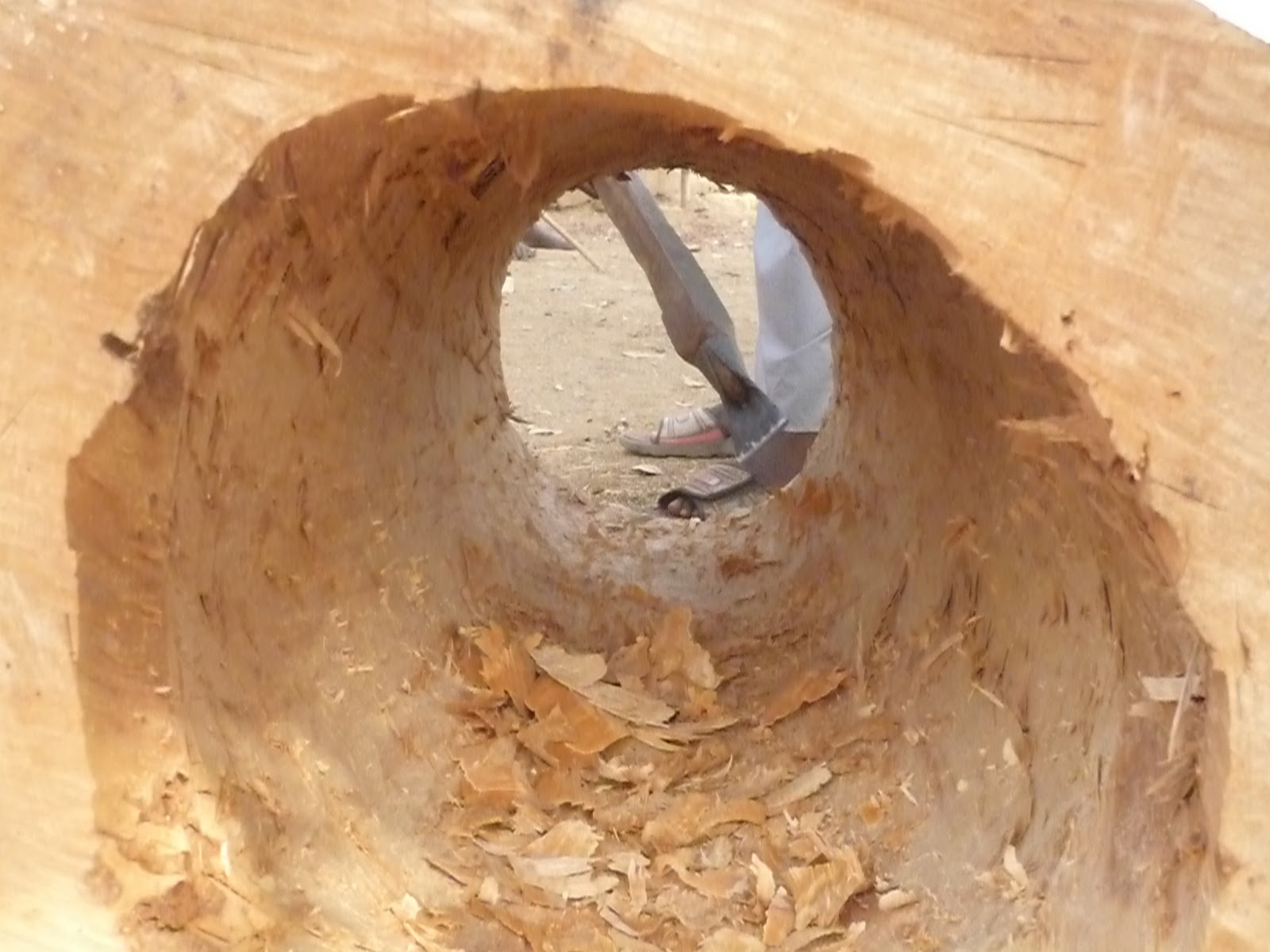
First, one must identify the appropriate species of tree, with the proper size trunk.  Then with your cutlasses and, perhaps if you're lucky, an ax or two, you must chop it down and cut a large chunk of trunk.  Then you and about 8 of your little brothers (and maybe sisters) have to roll it a couple of miles through the bush back to the house.


Once at the house, the long process of carving begins.  Everyone is invited to come, take the pole with the metal chisel wedged at the end of it, and take the middle of it out piece, by achingly small piece.  Have a competition with your neighbors to see who can do it the longest.


If your muscles get tired, you can lay it on the ground and exhaust a different set of muscles.


When the hollowing out is complete, run and get the specialist carver.  He has a chisel on a smaller pole and can round out the rough-shod trunk and make it look like a cylinder.


By tap-tap-tapping around the edge, he softens the corners, smooths out the wood, and begins to give the wood a drum-like shape.


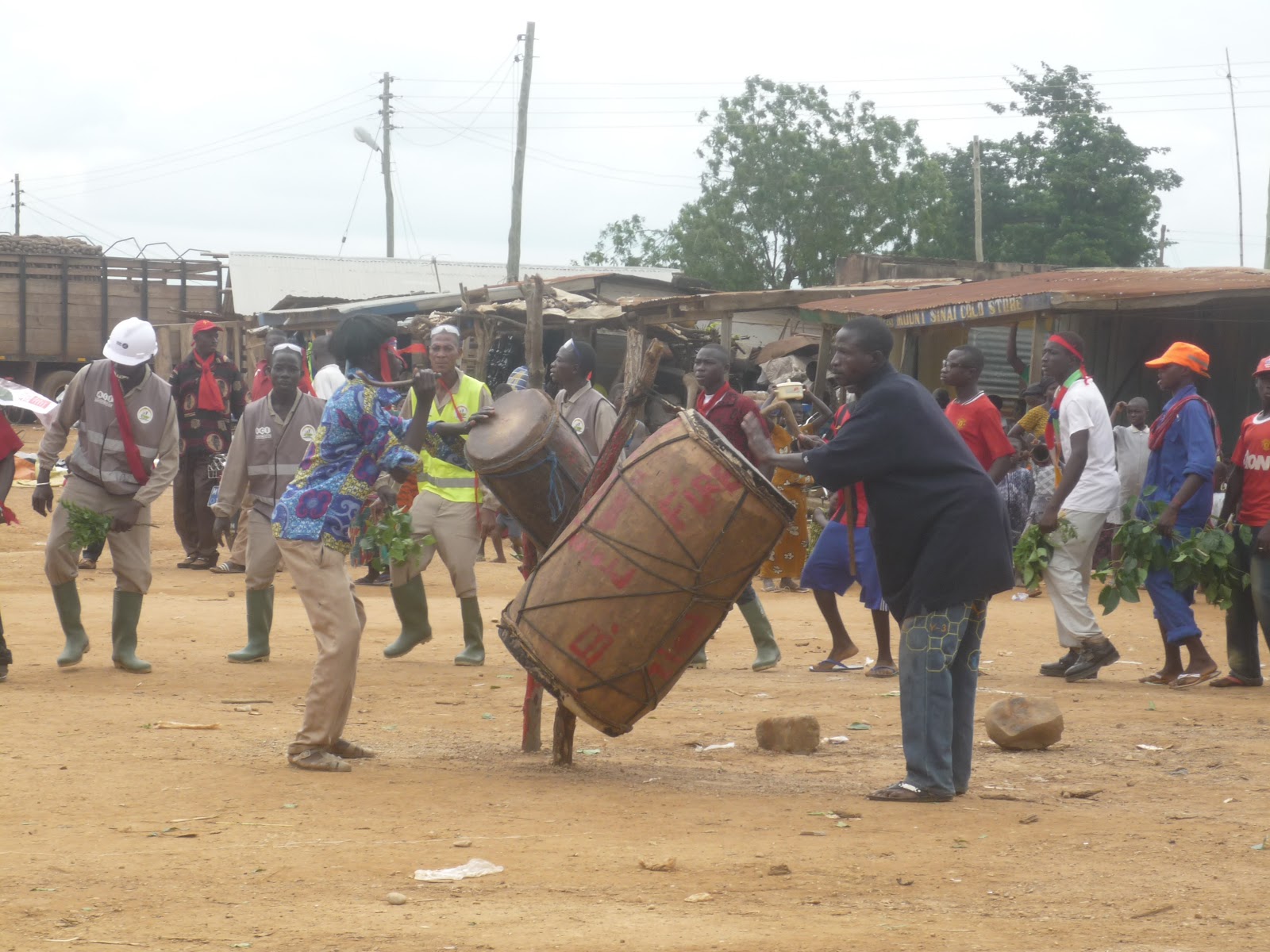
When the carving is finished, rub dirty oil into the wood to protect and stain it.  It also gives the instrument a nice, antique, and well-loved feel.  Now the final touches are just around the corner!  Run to nearest beef butcher, or wait until the cow sacrifice at a relative's funeral, and get the perfect cowhide to cover the ends.  Oil and stretch the rope as tight as you can, and you will have your own, extremely heavy, African drum.


Plant a forked pole from which your drum can hang and beat on it to your heart's content.  Guaranteed to draw your neighbors and relatives for all the Kinachung-ing and traditional dancing you can stand!


Wednesday, July 4, 2012

T minus 4 months


It's hard to believe that many of my “groupmates” are already home. I'm staying a little later than most, but it still feels so close and so far away at the same time. The first year went fast, the second year has been slower. I guess you can see that I'm excited to go home. It's senioritis all over again. Nevertheless, there are things being crossed off the list, and things poised to be crossed off soon. I have some self-supported girls that I have to set up with small businesses, so they have a means to care for themselves. I have library books to retrieve from two different places as well as the library system to set up and get underway. The organization that helped with our latrine project this year is coming to do some large scale health education with the beneficiaries. Operation Smile comes to Accra at the end of the month and I want to be among the volunteer troops, plus we're sending one child from Damanko to get his cleft lip fixed. And there's still some traveling to do, a handful of places in Ghana I still want to see.  I can feel the winding down happening.

Successes and Shortcomings


Now that the end is near, I begin to reflect more and more on what this experience has been. Lately, I've been wondering with quite disturbing frequency whether anything I have done here has actually done anything. All Peace Corps volunteers know this feeling comes. We all know our expectations can be high, and we all know we have to learn to manage those. We all know we have to look for the small, everyday successes, not wide-sweeping changes. We all know we have to manage the guilt of not being able to right all wrongs and injustices. It's unreasonable and damn near impossible. I have had this picture in my head of the work I do consistently over the past two years, a metaphor for how this “community work” goes. That picture is essentially a handful of carefully selected darts being thrown at a dart board at a long distance. I'm not a stellar dart player so some of the darts hit the wall, most hit the board, and once in a while I hit near the bullseye. I have always felt that the projects I've done, the information I give, the medium in which it is given, are like the darts—some hitting the board, some not. Somehow the ones that look like bullseyes at first drop outside the circle later and become vastly less satisfying. Over the course of service I have lived with this dart-throwing metaphor and been okay with it. I knew I wasn't going to “change the world” when I got into this business. I did wish, however, that, perhaps, I might change someone's world.

I have done a lot of things that will look very satisfying on a resume, things I will be glad to say “I did that,” “I experienced that.” Things that would make very good “successes” especially outside Peace Corps. It's been a busy month as we've been struggling to get started projects that have been in the works for ages, and wrap up others. It's been a bit of a self-confidence roller coaster as well, feeling both successful and dissatisfaction in everything.

First there was our Camp GGLOW, which was a lot the same as last year—30 some junior high school boys and girls, but we PCV organizers did try to tweak the focus of the curriculum a little. This time we decided to talk about gender inequality, reproductive health and sexual decision making. In order to tackle the widespread teen pregnancy problem, we decided to supplement the abstinence only education with lots of information about how to choose good partners and how to protect yourself from the risks of sex when you finally decide to have it or when you have no choice, because girls have a lot less power in the decisions whether or not to have sex than people like to admit. We talked about how pregnancy happens, biologically; what happens at puberty; about family planning; about proper condom use; and about HIV. We had guest speakers come and talk to the kids about gender roles and equalities, human rights, HIV and other things. Serious topics for a camp, right? But we also did fun and sort of frivolous things like watch The Lion King, paint calabash bowls, screen print camp T-shirts, produce a talent show, play Uno and dance the Hokey Pokey (which was a big hit, let me tell you). We PCVs even got a bunch of our pictures together to show them of America. We explained snow, fishing, weddings, Christmas trees and jack-o-lanterns, and Big Ten football games. The kids had a blast as did the staff, and though I always wish our Camp GGLOWs were more “campy”, I was never a sufficient enough camp counselor to make that happen. It's enough, I guess, to get them out of their villages, expose them to topics they often don't get to talk about openly, and meet other kids. It's trite and clichĂ© and a bit of a pity party, to wonder if what we did had any real impact on these kids. Camp GGLOWs all over Peace Corps have proven time and time again to be very successful and impactful projects, but essentially, in the midst of such insurmountable problems, how can even these immensely successful projects have any real impact? How can our teaching and advice to girls about sexual decision making, family planning, avoiding teen pregnancy, building self esteem, creating futures ever have any impact when teachers coercing girls to sleep with them is so wide-spread and so entrenched in Ghanaian schools? And that's only one example.

A week after we concluded the camp, I was back in Damanko doing a similar, truncated version of the program for our girls' football tournament. A few months back a couple of the teams came to Kwesi and asked if we could organize a tournament for them like we did for the boys last year. I gave them an enthusiastic “yes” as long as there was enough interest. Though there are plenty that like to play and play well, girls' football is a whole lot less organized. Still, it was a good opportunity to speak to them about teen pregnancy, about sex and family planning. Many of the schools organized teams and a couple groups from the town organized themselves into a couple of teams, so all in all, we had 8 teams for the tournament. Linda, a new PCV from the next town over, came by to help out and with her and Kwesi's help, we prepared a very successful education day the day before the tournament started. The girls played hard and everyone enjoyed watching them. The winner's bundle was enough sodas for everyone, a couple footballs, knit caps with professional football club patches on them, and a box of condoms. It's great to get so many girls together to talk about topics that are serious problems in their community and in their daily lives, but I still see so many blank faces looking up at me, because no matter how simply I try to explain things, the language barrier is still a problem. Sometimes it's still a problem even with a translator to help. Again, darts on a dart board. Which pieces of advice stick and how many do? I'm not sure we even made a dent in the “teen pregnancy problem,” but the event happened, things were taught, and the girls had fun. That's a success in one way.

I guess part of the problem is that a lot of the countable projects I've done over the past couple years have been big, focused, one-time events like this where we take one opportunity to educate as many people in one place at one time as possible. They require lots of planning, organization, thinking on your feet, money, and are easy to quantify in reports at the end. And when they're done, they're done and you can move on to the next thing. This style of community work is where I get the dartboard visual, because I never really know what impacts come of them. I don't know all the participants personally and I can't follow up on many of them in the future. Conventional Peace Corps wisdom says that our greatest impacts, our greatest work comes from the far smaller scale, one-on-one relationships we form—friendships and mentorships and such like. And to be honest, those are a lot more satisfying in the long run.

After these larger event-projects were finished, I was able to look to those relationships since they have no schedule. Things like one on one computer lessons for one student who has been bugging me for ages and really does deserve them. Or following up on that one seriously malnourished child that I saw at the clinic and taking a personal interest in his and his mother's diet. Or continue planning with a local NGO future meetings for our youth business group made up of girls who, for their own safety, need to learn independent business skills. Or rewarding Kwesi's brothers for helping run the tournament by organizing a match for their teams and giving them one of the prize footballs. These little things make me feel like a real Peace Corps Volunteer and I'm glad I don't have any more big events to do.

Friday, March 30, 2012

A Different Kind of Africa (Part 2)

Chameleon Hostel is definitely one of the best hostels I have ever stayed in—pool, bar, kitchen, tons of info. There is a great atmosphere, a great mix of people and plenty to do. I booked a bed for the night and asked the reception people about tours. The gal said there was a three day camping tour of Etosha leaving the next day, so I got excited. Once she called, however, they said they were full and couldn’t fit anyone else. I took their Master Binder of Tours and Things to Do, and sat down with my cheese and crackers to decide what I was going to do for the next four days. This was a serious low point. By the next morning, I was convinced I wasn’t going to go because a few different scenarios hadn’t worked out. One of the girls in the dorm room with me was living in Etosha and studying giraffes on a Fulbright, but there was no room left in the car she was taking, and I wasn’t sure how I was going to get around the park or back to the airport once I got there. A couple other ladies were thinking of renting a car, but nothing seemed to materialize there either. But in the morning, the Safari Lady arrived and seemed to work some magic. A tour guide had come to pick up three guests for an 8 day camping tour of Namibia—Etosha, the Namib Desert, and Soussusvlei (the biggest sand dune in the world). Since there were only three people, the Safari Lady got them to let me jump on for the first four days in which they were going to see Etosha and the town of Swakopmund, and then part from them on Wednesday morning and take a shuttle to the airport in Windhoek. And I can still pay the three day tour price. Oh it was so perfect! So I gathered my stuff, checked out, and hopped on the tour. And thus began my sojourn into the tourism side of Africa. And what a strange beast it can be.

When you enter into the world of the tours, you are essentially buying a certain kind of experience. Tourism, at least in Africa, is like a veneer that is hiding the more unsightly things but with a thin shiny gloss. Hence Namibia has good roads, running (hot) water in all the campgrounds, punctual appointments, quality restaurants with non-local imported food. Namibia looks more developed because without these things the hordes of 50-something German couples would not spend their big Euros there. Many people on a shoestring budget don’t go this way. They hole up at backpackers’ hostels, hitchhike to see things, rely on chance relationships and meeting and a flexible schedule to get them around places. There is less security, and more unknowns, but less money and a greater adventure, I guess. I suppose I am somewhere in the middle. Even the “cultural” tours can be a little canned. Let’s make tourists feel good by showing them the “real” Namibia, the people in the slums and opportunities to photograph the oldest traditional and isolated tribe in their bedrooms. Animals, rather than people, are better viewed in this zoo-like way and a better use of my money. Suffice it to say, I am glad and way happy to be on a camping tour with three other people rather than the enormous buses full of wealthy German tourists and all their earthly needs met. Though even the camping tour is quite pampering.

So we were off to Etosha. Me, Karrie—a woman from Texas, her daughter Erin (who seems to run in the same public health circles in DC as I do—small world), and her college friend Lou, an anesthesiologist from Stanford. And of course Millner, our tour guide. The first day was a long drive from Windhoek to the park and we didn’t do or see anything much except drive. I understood why people get such a kick out of traveling on a whim. It was so much more satisfying how this trip worked out than if I had planned it. It made it more exciting. We camped the first night on the border outside the park, welcomed by some springbok and a wildebeest. It was a beautiful day until we go to the campground when Mother Earth decided she needed some water and it poured down on us. It was quite miserable. Here we were, this new group of people (and me with no rain gear either—I was soaked), who didn’t know how to set up these particular tents and not looking world to cooking in the rain and a further wet night. Millner ended up setting up the tents with minimal help from us since we didn’t know how and like a trooper managed a delicious hot meal that made us all feel better.

The next day was our major day in Etosha, our game drive day. Basically, Millner drove us around the third of the park tourists could visit and we would see what we could see. I was hoping for elephants, but it seems it is the time of year that they migrate to the restricted area of the park. Elephants are a nuisance to most people because they see them too much, but I get to leave Namibia without seeing one. Despite the lack of elephants, the multitude of giraffes, zebras, lions, and the rare black rhino sighting tried to make up for it. I always enjoyed seeing giraffes in the zoo and had hoped that seeing them in the wild would be something special. I wasn’t disappointed. Seeing them nibbling from trees right next to your car, then mustering their lankiness into an unnatural looking lope is kind of special. The lions we saw had obviously spent the morning gorging themselves on some animal and were very happy and lazy and the juvenile cubs were lying right next to the road seeming to pose for the safari-ers, crouching and drinking from the puddles in the road. We also saw tons of antlered deer-like animals—springbok, impala, kudu, and a wildebeest or two, even a dik-dik here and there. There were a variety of beautifully colored birds, land birds, ostriches, and road runners. Our hunt for cheetahs, leopards, and rhinos was unsuccessful. We spent the night in a campsite within the park which was a campground in a national park like I’ve never experienced. They had fences and gates which they shut at sundown as well as 5 star lodges and 5 star camping. This camp Okankanejo is popular because they have bungalows right next to a lighted watering hole, which in the dry season is sure to draw all kinds of animals. This time of year though, it is smaller. In the morning we watched a large herd of zebra come for their morning refreshments. This time, the putting up of the tents went much swifter and we were all in a much better mood since we were dry. That night we listened as the jackals called to one another and ran through our campsite scavenging for food. In the morning we packed up early, had some yummy bacon and eggs and headed out to see what other animals we might see before heading for the desert. We were able to see some more wildebeest, oryx, a few hyenas loping through the grasses and the elusive black rhino. Unlike the other animals we saw that were near the road and conditioned show-offs, the rhino remained a tease by keeping his massive head down in the tall grass and partially concealing himself in the stick bushes, never coming completely out in the open, prompting the passengers in the “rhino jam” to go to questionable lengths to get his picture—like climbing on top of the car. We tore ourselves away from the rhino and continued on to the next place—Aba Huab in the desert.

After several hours of driving we were dropped off at a local tourist site the Damara people preserve showcasing rock carvings by nomadic Bushmen 2,000 to 6,000 years ago. In this land of burnt red sandstone are some of the most well-preserved carvings in Southern Africa. Bushmen hunters left tributes, records, and maps of herds of valued animals—lions, antelope, elephants, oryx, rhino, and giraffe. The most famous engraving is of a five-toed lion with an exceptionally long tail and an animal in its mouth. The interpretation is that 5 toes represents a human incarnation and it was believed that shamans could connect with the spirit world through animal spirits, thus the lion is a transformed shaman.

The next day we drove to the city of Swakopmund, another German city on the coast, but bigger than Luderitz. We passed from the beautiful red, rocky mountains to the desert plains near the coast. In the afternoon we were free to walk around and visit the markets and craft shops. The next day was a “free day” to spend as we liked, but it was my day to go to the airport. We walked around that afternoon trying to not be bothered by the somewhat desperate craft sellers, stopped at a cafĂ©, and walked through a couple stores. That night we cleaned ourselves up and went to the nice seafood restaurant on the water. I had a wonderful seafood kebab with several different kinds of seafood and tasty Chardonnay to go with it. Afterwards we headed to a local bar where I enjoyed a yummy Savannah Dry cider. It was the perfect way to spend my last night in Namibia.


Thursday, March 29, 2012

A Different Kind of Africa (Part 1)

I decided about a month ago to take a spontaneous holiday and have spent the last couple of weeks in Namibia. My cousin Leslie has been there for the last eight months and plane tickets were suddenly rather cheap so I took off from West Africa to see a bit of the Africa everyone dreams about. I wanted to see big animals, meet other Peace Corps Volunteers, and spend some time with a relative I never see. As far as those three things, the trip was a complete success.

I arrived at the Windhoek airport early on Thursday morning sleep deprived and curious. I got from the airport to the bus station via a connection of Leslie’s and settled in to wait for the next several hours until there were enough customers to leave. Windhoek kind of shocked me. I didn’t see much of it the whole trip, but it’s a very clean and modern city, full of new buildings, new cars, painted houses with high walls, interesting looking restaurants—a city like anyone would find in America and better than most. The car that was to take me to Keetmanshoop was new, operational, clean and spacious, quite dissimilar to my normal travel experiences in Ghana. As customers filled the car, I began to get a feel for the people in this new place—the sound of Afrikaans, the enormous diversity in skin color, and the sound of one of Southern Africa’s many “clicking” languages. Very musical and fun to listen to.

Eventually we left for Keetmans and as I watched (and we flew down a very smooth and well-maintained road, might I add) the land changed from mountainous to mid-western flat with fields and great herds of goats and cows. We arrived too late in Keetmans to get a car to Aus, so I stayed with a couple PCVs in that town. Two volunteers were living in a flat at the hospital’s quarters with two other Czech volunteers. Electricity, running water, apartment style housing, fridge, oven, etc. Is this Peace Corps? One of the PCVs, Will, was heading to Luderitz in the morning and Aus was on the way, so we headed out the next morning to find a car.

Namibia is very sparsely populated—especially in the south. There are only two million people in the whole country. Towns in the south are few and far between, so at every town almost every car has to stop and refuel. People looking for rides and drivers looking for customers often find each other at gas stations. So Will and I hunkered down at a gas station for a couple of hours until a “combi” (large van) going to Luderitz picked us up. It was a couple hours to Aus and the land changed again from Missouri to Utah. As the grasslands transitioned to the Namib Desert, mountains made of sandstone blocks erupted out of the ground. Sand, shrubbery, cacti, strange looking trees, and empty riverbeds were all that could be seen in the mountain beneath the cloudless blue sky. Aside from the lack of sage brush, it looked so very similar to the land that was Leanna’s and mine playground for so many years. In here was Aus and the Klein Aus Vista lodge that was Leslie’s workplace. We sat and had lunch in the lodge dining room (you have no idea how excited I was about that ham sandwich) on the balcony overlooking the desert and began our three or four days of nonstop talking. After collecting some fruits and veggies from the bosses for dinner that night, we walked to Leslie’s house in Aus and then took the five minute walk around Aus. You’d think (or at least I did) this would be a village, but it’s not. Aus is like a little resort town at low season—there’s nobody in it. But, like Windhoek, its clean, modern, and with nobody walking around. And the local people are in a lower income neighborhood across the street away from the town. Of course the best part was the short nightly ritual we set up having good German beer (dear God it was so good) outside on the Bahnhof Hotel deck where a couple nights later I enjoyed a dinner of kudu and ostrich kebabs.

Unfortunately, there’s not much to do in Aus except hike, or maybe visit the nearby wild horses from which the lodge earns its living. Hence the Texas-Cowboy-in-Africa feel that the lodge exudes. So we hiked to The Lookout—the sort hike over the rocks between the peaks of the mountains that are the barrier between the mountain desert and the moonscape into nothingness on the other side. 


That nothingness we crossed a couple days later on the way to Luderitz, an oddly placed, old German colony on the west coast of Namibia. Originally settled by German colonists in the 1800s(?) mostly because of the nearby rich diamond deposit, it is an odd mixture of beach and desert. Ocean on one side, flowing sand dunes on the other three sides. We walked around Shark Island; a place once used by the Germans in an early genocide of Africans, but today is a very windy camping park, the history invisible to its modern uses. And we went to Kolmanskuppe, a town built a few miles out of Luderitz purely to house the workers of the diamond “mine.” In fact most of the diamonds they found were lying on the surface. For 20 some years in the early 1900s, Kolmanskuppe was a thriving little town complete with theater hall, gymnastics equipment, a school, an ice factory, and a hospital with one of the earliest working x-ray machines, then it was abandoned abruptly and the surrounding desert is slowly burying it. Now it’s a destination for history buffs and, oddly enough, photographers of all abilities wanting to play with the site’s light and shadow abnormalities. We spent the morning playing and experimenting with our cameras, or, at least, I did.


While in Luderitz we stayed with a couple PCVs who were living in a flat in town. Will, my hitch hiking buddy from earlier was there and we all had a great time swapping our Peace Corps experiences over a wonderful dinner of rice and rogan josh curry with chicken. Mmmmm. As Thursday faded and with it my first week in Namibia, I was trying to find a way to see Etosha National Park, a long way to the north. It was becoming more and more apparent to me that I would feel incredibly stupid and regretful if I left Namibia without seeing the best wildlife viewing it had to offer. None of the tours seemed to be working out with my schedule, since it is the low season so less tours are booked. Since Leslie had to go back to Aus anyway to work, I decided to just travel to Windhoek the next day, and hole up at the popular Chameleon Backpacker’s Hostel and see if something would “work out.”


Saturday, February 18, 2012

I think I Created a Monster

Precious is a very precocious (no pun intended) 15 year old girl who is in her second class in junior high school. She is one of the top performing students so the teachers pick her for just about anything that needs school representation outside the school. And the best part? She LOVES books. Precious doesn't originally come from Damanko, but her family came from somewhere around Kumasi. She said when she was younger her grandmother used to make her spend the hours after school in the library there, and she developed a love for books. In Damanko, however, there is not much to read. The headmaster at the junior high school quickly found that Precious could not only read at a higher level than most of his students but was equally impressed by the level with which she could recite (not word for word of course) the stories she read. But he soon ran out of novels to give her. (I think the school has scavenged maybe a total of five books one of them being Huck Finn.) So he started sending her to my house. At first I gave her easy-to-read abridged classics I found for sale in Hohoe. She got through those in a couple of hours. Then I started giving her books from our informal Peace-Corps-pass-around library and at first I didn't have much that was suitable for a teenaged African girl, so I gave her Sisterhood of the Traveling Pants. She was excited that it looked like a grown-up book. Surprisingly, she had few problems reading or understanding it. Because of the rote memorization technique the schools employ here, students can usually read the words, but their comprehension is very low. After a couple easier children's novels, I gave her the big volume of the Chronicles of Narnia. I knew I had a winner there, because she devoured that book rapidly and her eyes lit up when she talked to me about it. She even kept it for a long time and read it through a second time. During all that time, I was collecting the Harry Potter books for her because various copies are in various Peace Corps offices and I even had to get the first book sent from home.

After about a month and a half, she is starting on the sixth book. One indicator of JK Rowling's genius is the ability of the books to evoke the same emotion in all its readers. Precious had never heard of Harry Potter before I gave her the books, never met anyone who had read them, and is totally isolated and ignorant about the Potter-mania that has sprung up and the cultural icon that is Harry Potter. Yet she acts like every other 15-year-old I ever saw that absolutely loves the books. Her mother tells her not to come and collect anymore, she is totally addicted. (I'm sure this makes me a bad influence.) I have all except the very last movie on my computer, so I've started letting her watch the movies and we only finished watching the first one today. Because many of the lines follow very closely with the book, she was predicting the actors' lines before they said them. And, no, of course she had never seen the movie before. She remembers nearly every little detail from any of the books she read; details such as that Filch is a squib, and she knows what that means. I had to convince her not to skip ahead in the movie because she was so curious to see what Quidditch looked like. She loves all the good characters and hates the bad ones with a vengeance. She is vehemently convinced of Snape's duplicity. Anytime the movie showed a panoramic view of the castle or flying on brooms, Precious would lament: “I wish I were a wizard!” She is certain all other books will be boring compared to the bright shiny world of Harry Potter. She would fit right in any of the Harry Potter fandom and there isn't much of that in Africa. Is the mark of a truly good story that it provokes similar behavior and emotions in all different people?

When she finishes the series, I'll tell her to take a break from books for a while (she may also need to catch up on her math practices), then I'll throw The Lord of the Rings at her and see what happens.